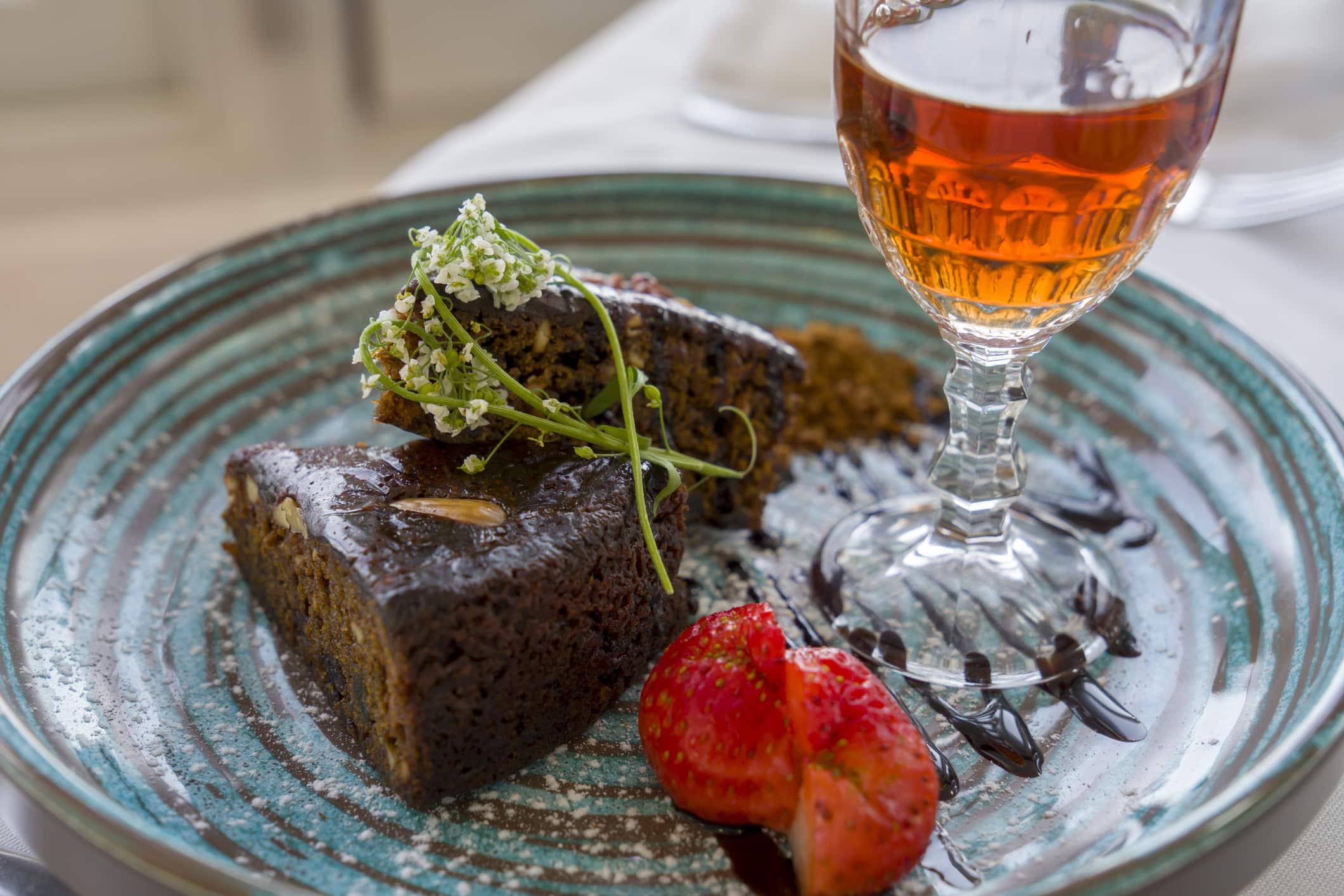
- Bolo de mel is one of Madeira’s oldest cakes. Despite the name (“honey cake”), there’s no bees’ honey in it – just sugar cane molasses (mel de cana).
- What’s inside: flour, warm spices (cinnamon, nutmeg, aniseed), nuts or candied fruit and Madeira wine.
- Tradition: it’s baked on 8 December and kept for months. It isn’t cut with a knife but broken by hand.
- Where to buy it: among other places, at Fabrica Santo Antonio and the Mercado dos Lavradores market in Funchal, and in supermarkets.
- A lighter version is the little broas de mel biscuits.
Bolo de mel is one of the oldest cakes baked in Madeira – the tradition goes back to the 15th century, when the island was Europe’s leading sugar cane producer. Despite the name (bolo = cake, mel = honey), it contains no bees’ honey – its base is mel de cana, sugar cane molasses. It’s a Christmas cake that islanders make on 8 December and keep for as long as a whole year.
Want to taste it on the spot? Compare Madeira wine tastings and food tours in Funchal on GetYourGuide.
History and cultural significance
When Madeira became “Portugal’s sugar plantation” in the 15th century, sugar cane syrup (mel de cana) was not only the main sweetener but also a natural preservative. That’s how bolo de mel was born – a cake that keeps for months, even years, without going stale.
The tradition of baking it on 8 December (the Feast of the Immaculate Conception) has survived to this day. In the past, families made dozens of cakes – enough for the whole of the following year. Today most islanders buy it from bakeries, but the ritual hasn’t changed: you don’t cut it with a knife, you break pieces off by hand. According to tradition, using a knife brings bad luck.
What’s inside bolo de mel?
The basic ingredients are:
- sugar cane molasses,
- wheat flour,
- warm spices (cinnamon, nutmeg, aniseed),
- nuts or candied fruit
- and Madeira wine.
It’s the molasses – a thick, dark syrup that’s a by-product of sugar refining – that gives the cake its distinctive caramel sweetness, dark colour and intense aroma. The texture is dense and compact – the cake is heavier and moister than gingerbread.
For every Madeiran, bolo de mel is the taste of childhood, but not every visitor will love it. It’s worth trying at least once, though, to understand why this cake matters so much to the islanders.
Broas de mel – a better alternative?
If bolo de mel turns out to be too intense, go for broas de mel – small round biscuits made to a similar recipe. They have the same base (molasses, spices) but a lighter texture and a more approachable flavour. They’re often sold in sets with bolo de mel.
Where to buy bolo de mel
The best places, according to local sources and my own experience:
Fabrica Santo Antonio (Funchal)
A traditional bakery that has been going since the late 19th century. They work from recipes more than 100 years old and wrap every cake by hand in boxes with vintage decorations. (According to an interview with a member of the bakery’s staff in the Polish news portal Interia, December 2025.)
Penha d’Águia (Funchal)
Especially recommended by guidebooks for the quality of its baking.
Mercado dos Lavradores (Funchal)
The farmers’ market – here you’ll find both bolo de mel and broas, often from local bakers. Prices may be higher than in supermarkets, but the atmosphere and the choice make up for it.
The shop in Calheta (next to the Sociedade dos Engenhos da Calheta sugar cane mill) A good place if you’re visiting the west of the island. Here you can see where mel de cana – the cake’s main ingredient – comes from.
Golden Gate Grand Cafe (Funchal)
This is where I bought the best bolo de mel, although I can’t especially recommend the café itself – right in the centre, sadly, the taste doesn’t keep up with the high prices.
Supermarkets (Pingo Doce, Continente) : I also bought broas de mel at Pingo Doce – handy if you’re doing your food shopping anyway. Decent quality, lower prices than in touristy places.
Madeira Airport: The last resort if you forgot to buy some earlier. There’s a choice, prices are higher, but you pay for convenience.
How to eat and store bolo de mel
The traditional way: Break off pieces by hand – it isn’t cut with a knife. Serve with coffee, Madeira wine or regional liqueurs (e.g. chestnut). It works as a dessert after lunch or a snack with your afternoon coffee.
Storing: Thanks to the molasses, the cake stays fresh for many months, even years. It doesn’t need the fridge – an ordinary kitchen cupboard will do. It makes an ideal souvenir that will survive the journey home.
Fun facts
- In the 19th century, families baked dozens of cakes a year – enough to last the whole year.
- Fabrica Santo Antonio wraps its cakes by hand in the same decorative boxes it used 100 years ago.
- Tradition forbids cutting it with a knife – it’s supposed to bring bad luck.
- The “Madeira cake” known in England is a completely different cake – named after Madeira wine, not after the island and not after bolo de mel.
- Molasses (mel de cana) was once the island’s main sweetener, before refined sugar became widespread.
Bolo de mel is more than a cake – it’s a piece of Madeiran history and a symbol of the islanders’ Christmas traditions. Not everyone will like it (the texture is dense and the flavour very intense), but it’s worth trying at least once to understand the cultural context. If it turns out to be too heavy, go for broas de mel, which are lighter and more crowd-pleasing.
It’s a better souvenir than a fridge magnet – especially as the cake will keep in your cupboard until your next trip to Madeira.
Looking for a plan for the day? Dolphin-watching cruises, jeep tours and sunrise on Pico do Arieiro, many with hotel pickup. Compare offers and reviews on GetYourGuide.