
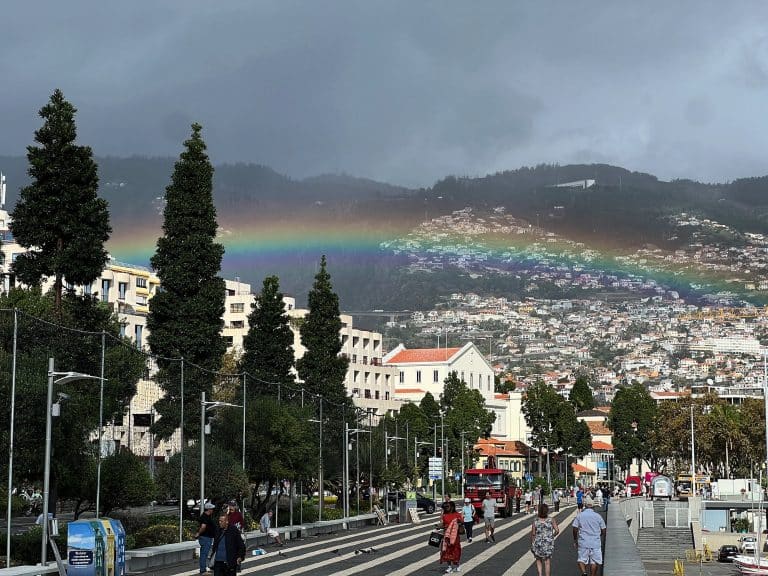
Madeira weather right now
The south, the north, the mountains and Porto Santo: now and for the next 3 days.
Funchalsouth coast, by the sea
–
Loading…
- today–
- tomorrow–
- day after–
Porto Moniznorth-west
–
Loading…
- today–
- tomorrow–
- day after–
Pico do Arieiromountains, 1818 m
–
Loading…
- today–
- tomorrow–
- day after–
Porto Santoneighbouring island, Vila Baleira
–
Loading…
- today–
- tomorrow–
- day after–
🌊 Sea off Funchal: –
🌅 Funchal today: sunrise –, sunset –
Before you head out: live webcams · sunrise on Pico do Arieiro · trail status · IPMA warnings
Forecast from a weather model, updated every hour. Data: Open-Meteo (CC BY 4.0), sea: Open-Meteo Marine ocean model, warnings: IPMA. Madeira’s weather changes fast, and in the mountains and on the north coast it can be completely different from Funchal.
One March morning I was sunbathing on the terrace. Then I went for a walk to Monte Palace and got caught in such a downpour that within 5 minutes I was soaked to the skin. An hour later the sun was out again. So much for weather forecasts in Madeira.
Over time I learned to recognise the rain clouds rolling down from the mountains — and that turned out to be more reliable than any weather app. I’d recommend a healthy dose of caution to you too: use the forecasts for Madeira, but expect the conditions to change.
The average annual temperature in Funchal is 20.0°C, and the difference between the coolest and the warmest month is just 7 degrees — but that stability applies to averages, not to individual days. To plan your stay well, it helps to understand how Madeira’s weather really works.
Looking for a place to stay in Madeira? Compare hotels, apartments and houses across the island on Booking.com, with reviews and free cancellation on many offers.
What shapes Madeira’s climate?
The island’s climate comes down to three factors that are worth understanding before you start packing.
You feel the difference between the north and the south straight away — a few degrees cooler, more green, a different wind. The same goes for levadas, which often run higher up in the mountains: even when it’s very warm in Funchal, you can get cold walking in the shade on the higher parts of the island.
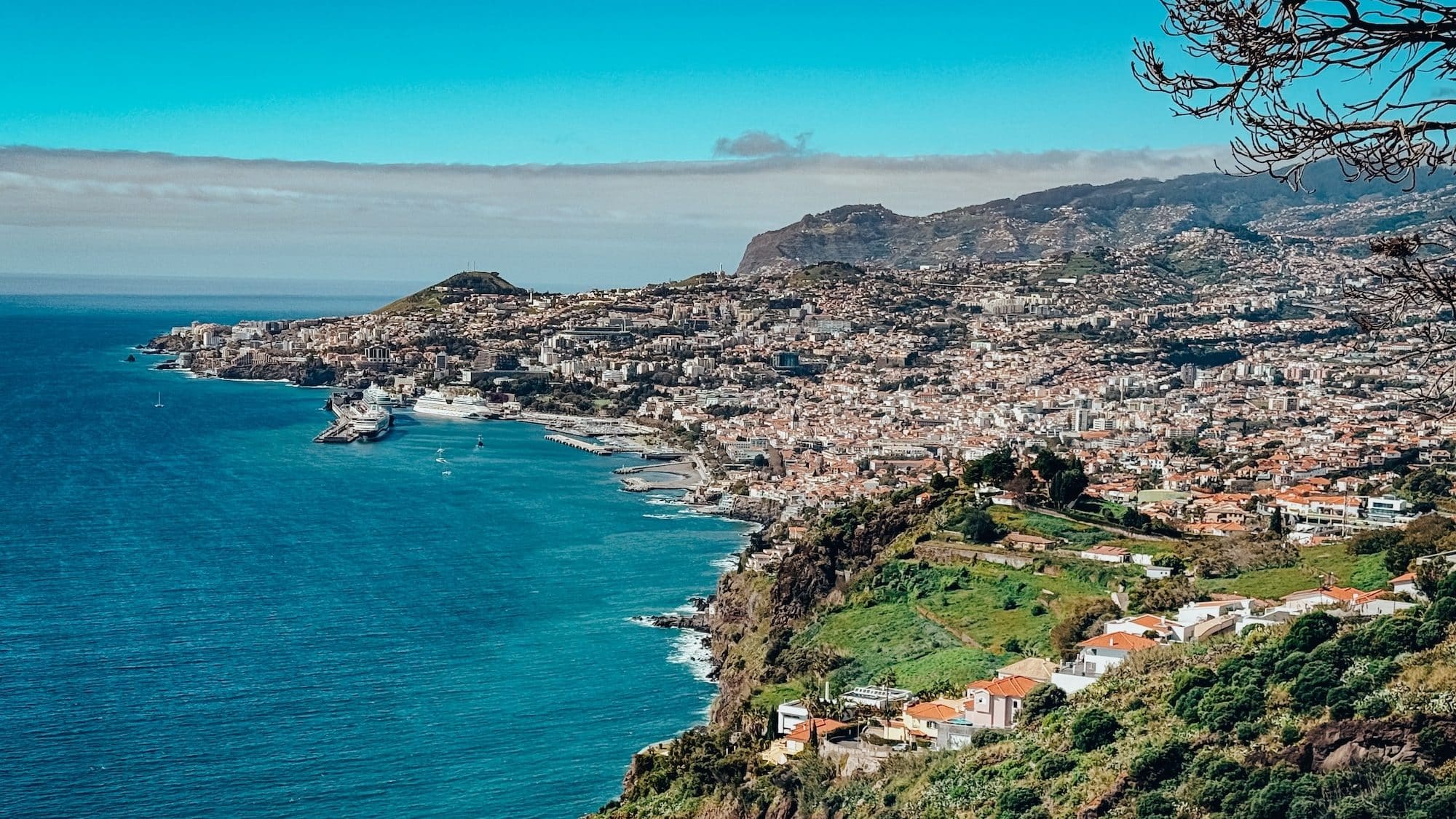
South vs north Madeira: two faces of one island
This is key information for anyone planning a stay in Madeira, and most guides either skip it or only skim the surface.
When to go to Madeira? Compare the months
Tick what matters to you and I’ll rank the months from best to worst. Climate data for Funchal from long-term averages (IPMA and DWD 1991–2020), sea temperature from the table below.
Averages can’t tell you what the weather will be like in a particular week. In the north of the island and in the mountains it’s cooler and rains more often than in Funchal. Events: Carnival (February), the Flower Festival (late April to late May), the Madeira Wine Festival (late August to mid-September), Christmas lights and New Year’s Eve (December).
Madeira temperatures by month
Madeira is famous as the “island of eternal spring” — and the climate data confirm it’s not an empty slogan. The figures below come from the official IPMA station at Funchal Observatory (58 m above sea level) and reflect conditions on the south coast.
Funchal’s annual average is 20.0°C: from 16.8°C in February to 23.7°C in August. Daytime highs are about 20°C in winter and 25–27°C in summer; at night it’s 14 to 21°C.
| Month | Day / night | Sea | Rainy days | Sunshine |
|---|---|---|---|---|
| January | 20° / 14° | 19.1° | 6 | 161 h |
| February | 20° / 14° | 18.5° | 5–6 | 167 h |
| March | 21° / 14° | 18.2° | 6 | 198 h |
| April | 21° / 15° | 18.7° | 5 | 195 h |
| May | 22° / 16° | 19.6° | 3 | 209 h |
| June | 24° / 18° | 21.0° | 1 | 194 h |
| July | 25° / 20° | 22.5° | <1 | 233 h |
| August | 27° / 21° | 23.4° | <1 | 237 h |
| September | 27° / 20° | 23.8° | 3 | 211 h |
| October | 25° / 19° | 23.2° | 7 | 194 h |
| November | 23° / 17° | 21.7° | 7 | 166 h |
| December | 21° / 16° | 20.2° | 9 | 151 h |
🌸 Madeira weather in spring
Spring in Madeira is a transition: the rain gradually eases off and temperatures start to climb. It’s a great time for hiking — the trails are green after the winter rain, and it hasn’t yet reached summer highs.
Madeira weather in March
In short: about 21°C by day, 14°C at night, rain on 6 days (62 mm), sea about 18°C, the coolest of the year. More in Madeira in March.
In March the camellias are still flowering in the gardens (their season runs from November to April), and in the mountains the mimosa — an invasive species — is in yellow bloom. The jacarandas in Funchal won’t flower until the end of April. Rain is still frequent, but longer sunny spells are starting to appear.
Madeira weather in April
In short: about 21°C by day, 15°C at night, rain on 5 days (45 mm), sea about 19°C.
April brings noticeably warmer weather and less rain. The Festa da Flor (Flower Festival) starts at the end of April and runs until the end of May (in 2027: 29 April – 30 May, with parades on 2 and 16 May) — and for good reason: the island is at its most colourful then.
Madeira weather in May
In short: about 22°C by day, 16°C at night, rain on 3 days (27 mm), sea about 20°C, around 209 hours of sunshine.
May is one of the best months to visit — warm enough for the beach, minimal rain, and still no crowds on the trails. The UV index goes above 10 — SPF50 sunscreen is a must.
🌞 Madeira weather in summer
Summer in Madeira isn’t as scorching as on the European mainland, but it can still surprise you. In July and August the temperature in Funchal regularly tops 25°C, and hot air masses from the Sahara sweep in over the ocean — a phenomenon called Leste.
Madeira weather in June
In short: about 24°C by day, 18°C at night, rain on 1 day on average (8 mm), sea about 21°C.
June marks the start of the dry season. A typical sight is the capacete (“helmet”) — a layer of cloud that covers the island in the morning but breaks up during the day. Rain is rare.
Madeira weather in July
In short: about 25°C by day, 20°C at night, almost no rain (1.7 mm for the whole month), sea about 22.5°C. On average, 19 days reach at least 25°C.
July is one of the driest months — on average just 1.7 mm of rain falls in the whole month. It’s the peak of the tourist season: the trails are busy and accommodation prices are at their highest.
Madeira weather in August
In short: the warmest month: about 27°C by day, 21°C at night, almost no rain (1.3 mm), sea about 23.5°C, the most sunshine of the year (237 h).
August is the warmest month in Madeira. The highest temperature recorded in Funchal in 1991–2020 was 38.2°C (9 August 2016). During Leste episodes, hot air from the Sahara brings fine red dust. Temperatures above 35°C happen in Funchal about once every 5 years on average, and above 30°C on about 2–3 days a year. It’s also the sunniest month — almost 237 hours of sunshine.
Leste is a strange feeling — a warm wind on your face that brings no relief and actually makes the heat even more intense.
🍂 Madeira weather in autumn
Autumn is an underrated season in Madeira. Temperatures are still high (especially in September and October), the ocean is at its warmest, and the summer crowds have gone home.
Madeira weather in September
In short: about 27°C by day, 20°C at night, rain on 3 days (23 mm), sea about 24°C, the warmest of the year.
September may well be the best month to visit Madeira. The air is almost as warm as in August, the ocean is at its warmest (23.8°C on average), and the rain is only just starting to come back. There are far fewer visitors than in summer.
Madeira weather in October
In short: about 25°C by day, 19°C at night, rain on 7 days (91 mm), sea about 23°C.
October is a turning point — rainfall jumps from 23 mm in September to over 91 mm. Rain in Madeira can be violent: it can reach 500 mm in a single day, and the heaviest downpours happen in autumn and early spring, often within just 2–3 hours. Even so, October still offers warm days and temperatures above 22°C.
Madeira weather in November
In short: about 23°C by day, 17°C at night, rain on 7 days (80 mm), sea about 22°C. More in Madeira in November.
Statistically, November is a rainy month, but the temperature stays at a comfortable level close to 20°C.
My visit in November 2023 turned out to be full of sunshine — I didn’t have to change a single plan because of rain. Statistics are one thing, but reality can surprise you in a good way.
🌿 Madeira weather in winter
Winter in Madeira is a relative concept. While much of Europe is dipping below freezing, daytime highs in Funchal still hover around 20°C. That’s what makes Madeira one of the most popular winter escapes for Europeans.
Madeira weather in December
In short: about 21°C by day, about 16°C at night, rain on 9 days (95 mm, the most of the year), sea about 20°C.
December is the rainiest month of the year and has the fewest hours of sunshine. But it’s also the month of the legendary New Year’s Eve — the fireworks in Funchal draw thousands of visitors. Despite the rain, 21°C days are not unusual.
Madeira weather in January
In short: in Funchal about 20°C by day, 14°C at night, rain on 6 days on average (67 mm), sea about 19°C. There can be snow in the mountains.
January is cooler but still mild. It can snow in the mountains — Pico do Arieiro and Pico Ruivo get a white cap, which makes a surreal sight from sunny Funchal.
Madeira weather in February
In short: the coolest month: about 20°C by day, 14°C at night, rain on 5–6 days (72 mm), sea about 18.5°C. More in Madeira in February.
Statistically, February is the coolest month in Madeira, but even then the average night-time temperature is 13.9°C. The lowest February temperature recorded in Funchal in 1991–2020 was 8.7°C (16 February 1996), and the lowest of the whole year 8.5°C (15 March 2011) — still a long way from frost. Madeira holds its Carnival in February — one of the most colourful in Europe.
During my workation in February and March 2025 it rained on roughly two-thirds of the days — but that needs some context. Often these were 10-minute showers, followed by sunshine for the rest of the day. Changeable weather doesn’t mean a lost day. My visit in February 2026, on the other hand, was sunshine practically all the time — just the odd cloudburst. Every stay is different, but even a “rainy” winter in Madeira is warmer than a Polish autumn.
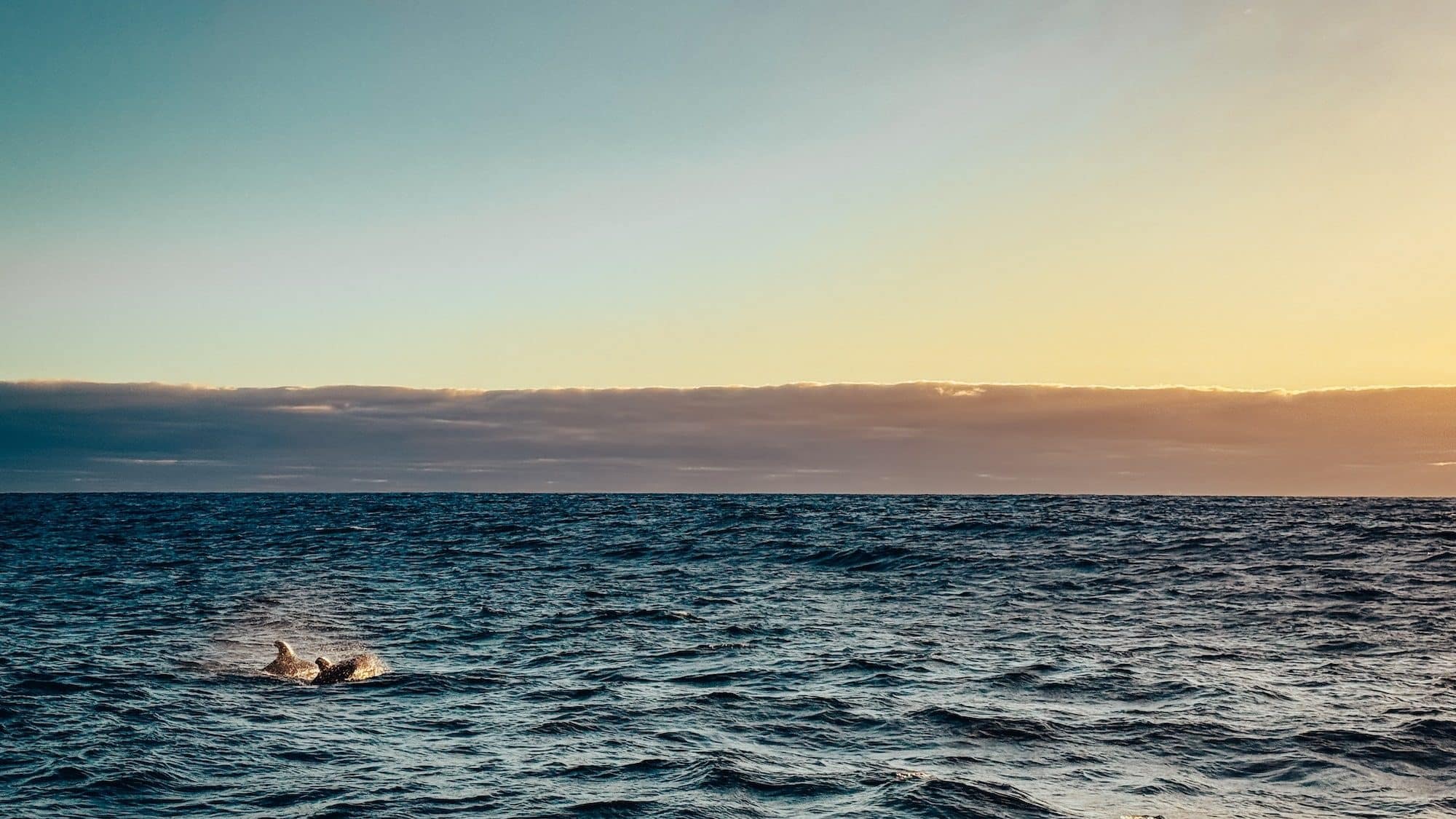
Sea temperature in Madeira
The ocean around Madeira is warmer than you might expect from the Atlantic at this latitude — thanks to the Gulf Stream. The average water temperature ranges from about 18–19°C in winter to 23–24°C in September, the warmest month for sea temperature.
🌊 Average sea temperatures in Funchal
Source: seatemperature.info — averages from NOAA satellite measurements, 2015–2025, accessed 16 October 2026
The sea is warmest in September (23.8°C on average) — the best time for a swim in the ocean. But even in winter the water doesn’t drop below 18°C, which makes Madeira one of the few places in Europe where you can swim in the sea all year round (if you’re hardy!). Madeira is big on lidos — seawater pools fed by the ocean, which make for slightly more comfortable swimming than the open sea.
In February 2026 my husband and our friends swam in the natural pool in Seixal, while I just dipped my feet in. The water isn’t icy, but it takes a moment to get used to. If the Baltic in early summer doesn’t scare you, winter Madeira won’t surprise you either.
Weather in different parts of Madeira
Madeira is small (57 × 22 km), but its varied terrain means the weather can differ dramatically between places only a dozen or so kilometres apart.
Funchal weather
Funchal (on the south coast, 0–600 m above sea level) is the warmest and most wind-sheltered place on the island. The amphitheatre of mountains around the capital works like a natural umbrella. Annual rainfall: about 574 mm. Annual sunshine: about 2314 hours. Humidity stays fairly steady at 68–73% all year round.
During the month I lived in Funchal (February–March) I got to know the rhythm of the late-winter weather here. Although it was generally fine, you could expect a quick cloudburst once or twice a day. Especially when strong winds dragged rain clouds from the mountains over the city. It lasts 10–15 minutes and then the sun is back. You simply have to get used to it and not let a single cloud dictate your day.
Câmara de Lobos weather
Conditions similar to Funchal — a sheltered bay on the south coast, a few kilometres west of the capital. One of the warmest places on the island.
Calheta weather
Calheta, on the south-west coast, is known for one of the few sandy beaches in Madeira. The area is one of the driest on the island — its climate is described as “distinctly Mediterranean”, with dry conditions from April to October.
Ribeira Brava weather
Ribeira Brava lies on the south coast, in a valley that leads inland towards Encumeada. The town itself has typical south-coast weather, but drive 15 minutes up the valley and you’re in a completely different climate.
Porto Moniz weather
Porto Moniz, at the north-western tip of the island, is where the Atlantic crashes into the rocky coast. It’s famous for its natural volcanic pools. The weather here is noticeably moodier than in the south — more wind, rain and cloud. The waves can be huge — off Porto Moniz they can reach several metres.
São Vicente weather
São Vicente, in the middle of the north coast, is the gateway to several levada walks. As a northern town, it gets much more rain than Funchal. The green São Vicente valley is one of the wettest and lushest on the island.
Santana weather
Santana, on the north-east coast, is the starting point for many popular trails (including Caldeirão Verde and Pico Ruivo from Achada do Teixeira). The weather here is wetter and cooler than in the south, but the landscape more than makes up for it — this is where the island’s best-developed laurel forest has survived.
Weather on Pico do Arieiro and Pico Ruivo
On the peaks above 1500–1800 m above sea level it’s on average 10°C colder than on the coast. Frequent fog, sudden changes in the weather and strong wind are everyday things. In winter the peaks are covered in snow, and the wind in the mountains can reach 100 km/h.
I once drove up to Pico do Arieiro for sunrise. In Funchal it was 14–15°C at dawn; at the summit it was -1°C and snow had fallen. Shortly after I got up there, the trails were closed. The views were stunning — a sea of clouds beneath my feet, rust-red rocks in the first rays of the sun — but if I had gone a day later, I wouldn’t have made it to the top. It’s the best example of how quickly the weather changes in Madeira’s mountains.
Practical tip: Even if it’s 25°C and sunny in Funchal, it can be 10–15°C with a biting wind on Pico do Arieiro or Pico Ruivo. Always take a warm fleece, a windproof jacket and something waterproof on mountain trails — even in summer.
Weather on Paul da Serra
The high Paul da Serra plateau (about 1400 m above sea level) is an unusual place — flat ground on an otherwise very mountainous island. It can be foggy and windy, but on clear days the views stretch all the way to Porto Santo. The plateau is the starting point of the PR13 trail to the laurel forest at Fanal.
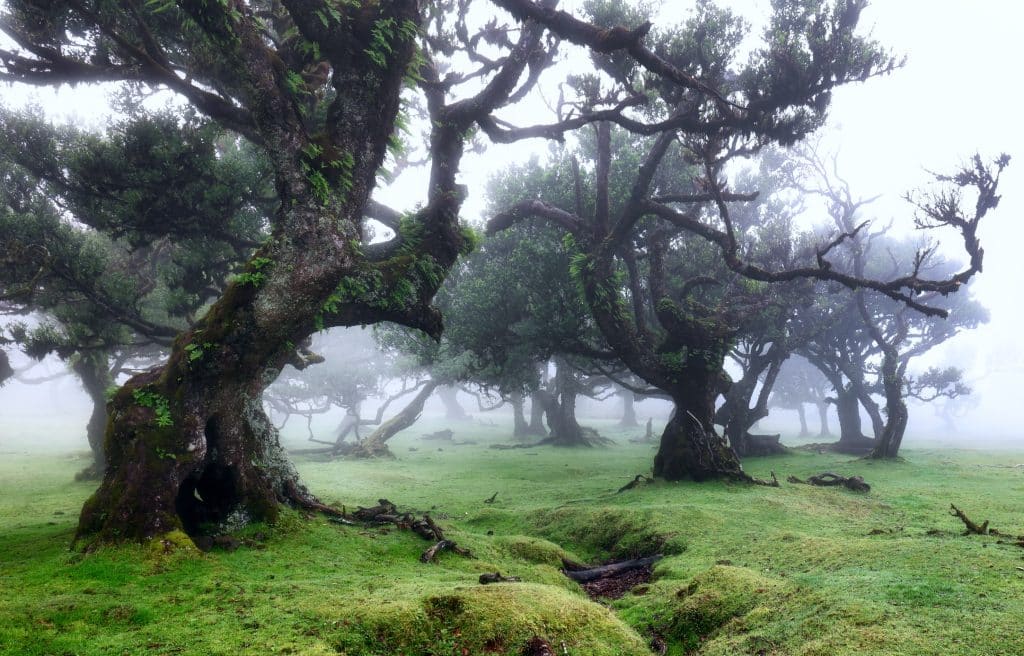
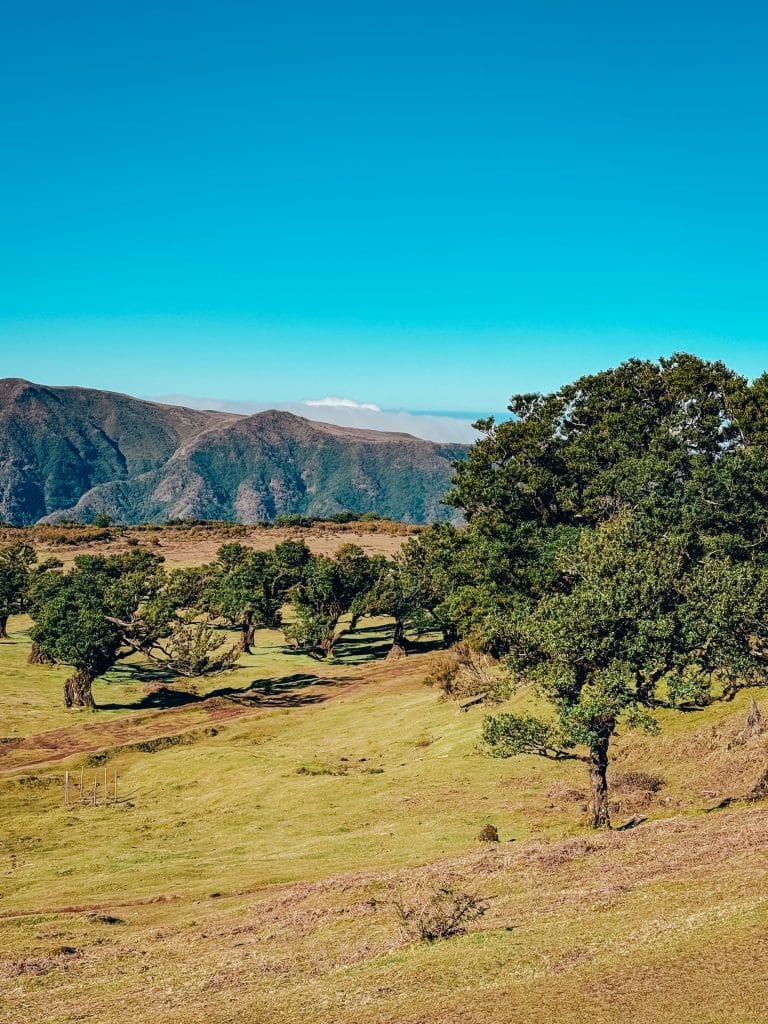
Photo: Ewelina Podrez-Siama – February 2026
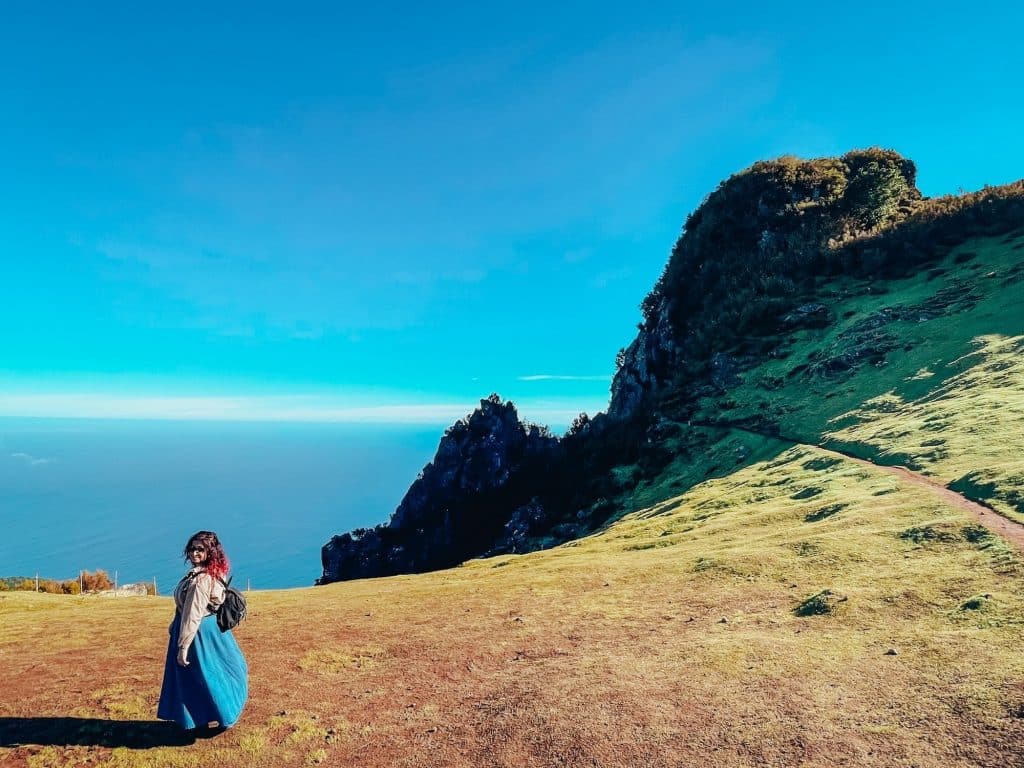
Photo: Ewelina Podrez-Siama – February 2026
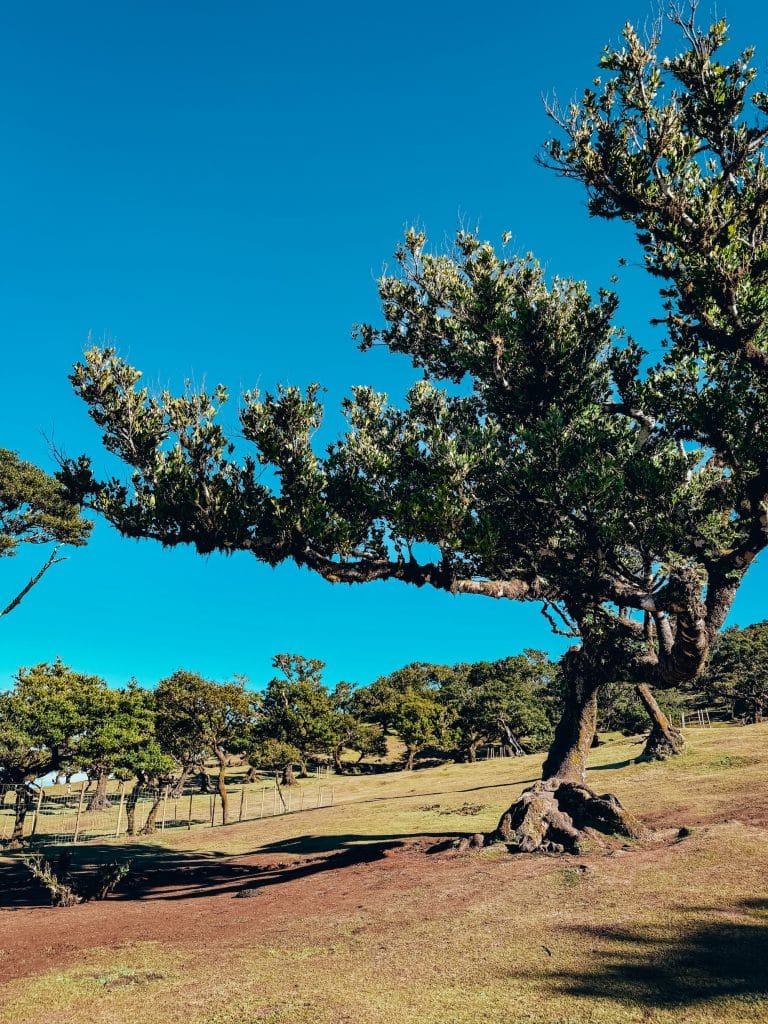
Photo: Ewelina Podrez-Siama – February 2026
1: Fanal forest wrapped in its typical fog – lichen-covered til trees loom out of the grey, creating a mystical atmosphere. This is how Fanal looks several times a week, most often early in the morning.
, 2: Twisted til trees scattered across the green plateau against the mountains of central Madeira. Their typical shape – low, wide-spreading crowns sculpted by the wind.
Photo: Ewelina Podrez-Siama – February 2026, 3: A path across the plateau with views of dramatic rock formations and the ocean. On a cloudless day Fanal feels completely different from the foggy version – the panoramic views make up for the missing mystical atmosphere.
Photo: Ewelina Podrez-Siama – February 2026, 4: A lone til tree with its typical horizontal branch and lichen on the bark. On a sunny day you can see every detail – the texture of the bark, the green lichen, the way the branches spread.
Photo: Ewelina Podrez-Siama – February 2026
Weather on Porto Santo
Porto Santo, Madeira’s smaller sister (43 km²), lies about 43 km to the north-east. Its climate is completely different — it’s flat (highest point 517 m) and much drier (about 382 mm of rain a year versus 574 mm in Funchal), but not warmer: the annual average is 19.1°C, against 20.0°C in Funchal (IPMA 1991–2020). Its climate is classified as semi-arid (BSh in the Köppen system). Porto Santo is brownish and dry for most of the year, except in spring, when it turns green.
The 9-kilometre sandy beach on Porto Santo makes it the perfect beach add-on to mountainous Madeira.
Clouds in the north, sunshine in the south? Madeira’s weather can change every few kilometres. With a car you can drive to wherever the sun is out. Compare car hire prices at Madeira Airport (FNC) on DiscoverCars.
Best time to visit Madeira: a practical weather guide
Madeira is a year-round destination — that’s not marketing, it’s a fact backed by data. But every season has its pros and cons.
Personally, I love late winter and early spring, when the weather in Poland is at its least charming — I escape to Madeira for a dose of sunshine and greenery. But a local guide once told me something interesting: most visitors fly in during winter, escaping the European cold, so paradoxically the island is quieter in summer. It’s still on my to-do list — summer in Madeira without the crowds.
What to pack for Madeira: a clothing list
Whatever the season, the key to staying comfortable in Madeira is layers. It can be 25°C on the coast and 12°C with wind and fog on a trail at 1000 m.
- Waterproof, windproof jacket — even on summer trails
- SPF50 sunscreen — the UV index reaches 11!
- Sunglasses
- Hiking boots with good grip — wet stones on the levadas are slippery
- Long trousers for the trails
- Light layers
- A warmer jacket or fleece — for evenings and mountain trails
- Umbrella — for rain in town, not for the trails
- Swimwear — for lidos and natural pools
- Sun hat / cap
- Water shoes — for rocky entries into the ocean
From my own experience: what matters most is layers and a jacket that keeps out both rain and wind, plus good shoes and long trousers for the trails. I packed far too many in-between-season clothes — in Madeira, spring and summer clothes for town plus a solid supply of hiking gear are enough. Better one good jacket than three so-so hoodies.
Madeira weather: frequently asked questions
What’s the weather like in Madeira right now?
The box at the top of this page shows the current temperature, wind and a 3-day forecast for Funchal, Porto Moniz, Pico do Arieiro and Porto Santo. The data refresh every hour.
What is the warmest month in Madeira?
August. In Funchal the average temperature is 23.7°C: 26.8°C by day and 20.7°C at night on average (IPMA 1991–2020).
When is it coldest in Madeira?
In February: 16.8°C on average, 19.9°C by day, 13.9°C at night. There is no frost in Funchal. The lowest temperature in 1991–2020 was 8.5°C (15 March 2011).
When does it rain least and most in Madeira?
July and August are the driest: 1–2 mm of rain a month. The wettest months are December (94.8 mm, about 9 rainy days) and October (91.2 mm). These figures are for Funchal. The north and the mountains get much more rain.
What is the sea temperature in Madeira?
From about 18°C in March to about 24°C in September (2015–2025 averages, seatemperature.info). The box at the top of the page shows the current sea temperature off Funchal.
Is Madeira warm in winter?
On the coast, yes. In December and January Funchal averages 20–21°C by day and 14–16°C at night. In the mountains there can be frost, and the peaks sometimes get snow.
How is the weather in Funchal different from the north of Madeira?
The south is warmer and drier because the mountains block the moist north-east trade wind. The north (Porto Moniz, Santana, São Vicente) gets more cloud, wind and rain. On Pico do Arieiro (1818 m) it is on average about 10°C cooler than by the sea.
What is the weather like on Porto Santo?
Porto Santo is drier than Madeira: about 382 mm of rain a year, compared with 574 mm in Funchal. It is not warmer: the annual average is 19.1°C, against 20.0°C in Funchal (IPMA 1991–2020).
Extreme weather and safety
Madeira is not a tropical paradise immune to the elements. The island has seen some dramatic weather episodes that are worth knowing about.
Read next:
- Flight disruption risk calculator
- Madeira Airport (Funchal)
- Madeira trail status
- Madeira live – webcams
📚 Bibliography and sources (8)
- IPMA — Normal Climatológica – Funchal, 1991–2020. Instituto Português do Mar e da Atmosfera. PDF · Data: air temperature (mean/min./max.), rainfall, rainy days, humidity, records.
- Baioni, D. (2011) — Human activity and damaging landslides and floods on Madeira Island. Natural Hazards and Earth System Sciences, 11, 3035–3046. doi:10.5194/nhess-11-3035-2011 · Data: rainfall in the north vs the south, rainfall extremes, history of floods.
- Pinheiro de Carvalho, M.Â.A. et al. (2022) — Anticipating the Climate Change Impacts on Madeira’s Agriculture: The Characterization and Monitoring of a Vine Agrosystem. Agronomy, 12(9), 2201. doi:10.3390/agronomy12092201 · Data: climate types, temperature gradient with altitude, projected changes.
- NOAA — Funchal Climate Normals, 1961–1990. National Oceanic and Atmospheric Administration. · Data: relative humidity.
- DWD — Monthly Averages for Funchal, 1991–2020. Deutscher Wetterdienst (German Meteorological Service). · Data: sunshine (hours/month).
- DREM — Índice Ultravioleta, Estação Meteorológica Funchal/Observatório, 2015–2020. Direção Regional de Estatística da Madeira. · Data: average UV index.
- Seatemperature.info — Funchal Water Temperature. Monthly averages from NOAA satellite measurements, 2015–2025. seatemperature.info, accessed February 2026.
- Meteogram.org — Sunrise and Sunset Times, Funchal 2026. meteogram.org, accessed February 2026.
The author’s own observations from her stays in Madeira: November 2023, February–March 2025 (workation, 1 month in Funchal), February 2026.
Looking for a plan for the day? Dolphin-watching cruises, jeep tours and sunrise on Pico do Arieiro, many with hotel pickup. Compare offers and reviews on GetYourGuide.