
- Where: a municipality on the north coast, 6553 inhabitants. About 39 km from Funchal, 45–60 minutes by car.
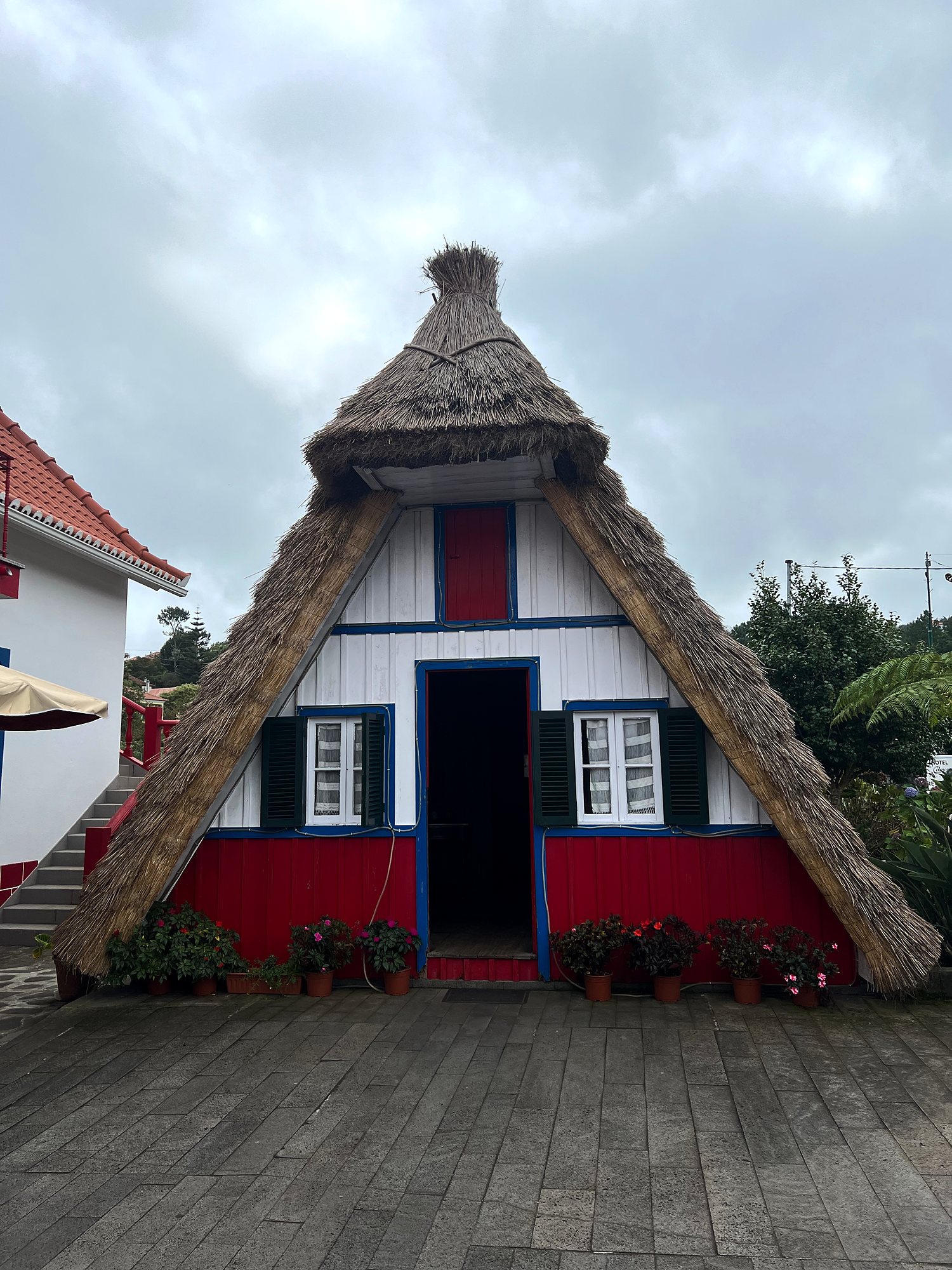
- The houses: triangular casas de colmo with thatched roofs at an angle of about 60°. The municipality’s 2024 list includes 81 of them.
- By the town hall: houses with little shops selling local products, and a viewpoint. The tourist information point is temporarily closed.
- Parque Temático: Tuesday–Sunday 10:00–18:00, ticket €13.
- Closed: the Rocha do Navio cable car (since May 2026), and PR9 only goes as far as Caldeirão Verde.
- Weather: it rains twice as much here as in Funchal, so a jacket comes in handy even in summer.
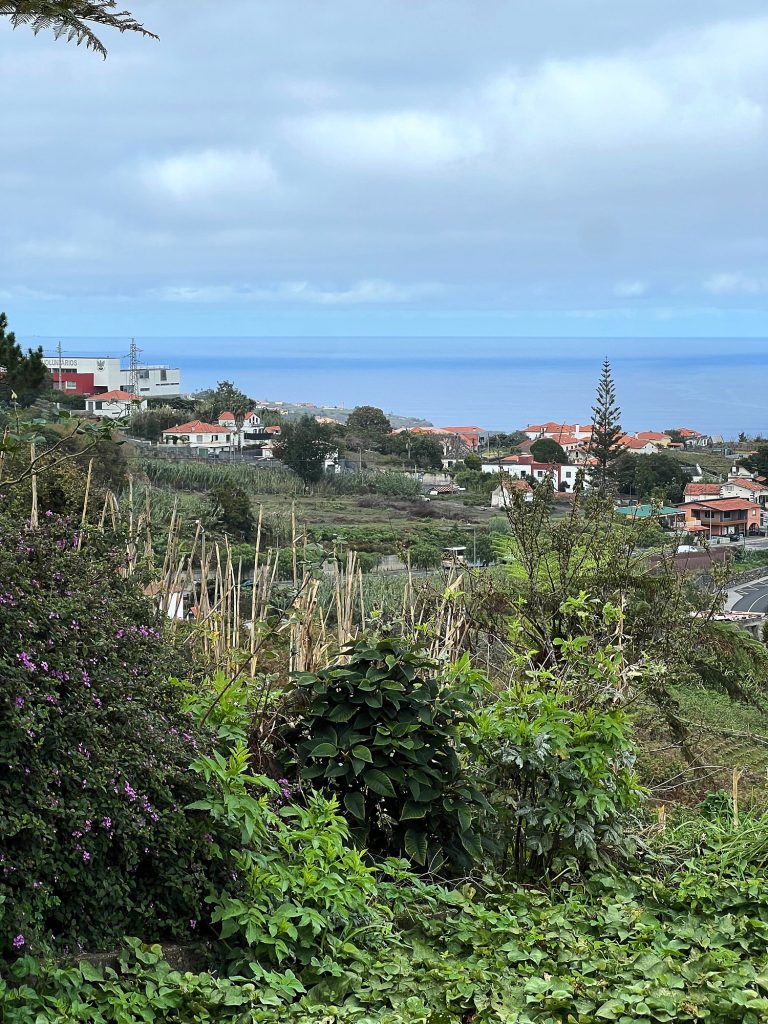
I was in Santana in November 2023. It was full of tourists. My photos from that day show the colourful thatched houses, the inside of one of them, the view from the town to the ocean and misty valleys along the way.
Below I’ve gathered where the triangular houses came from, where to see them, how to get to Santana by car and by bus, what’s open in the area (and what’s closed) and what the weather is like. I checked the figures against sources from the municipality, the biosphere reserve, Visit Madeira and IFCN.
A car from the airport: compare car hire prices at Madeira Airport (FNC) on DiscoverCars.
Where is Santana?
Santana is a municipality on Madeira’s north coast, created in the 19th century. In 2001 Santana was granted town status as “the first city of the 21st century”. The municipality has 6 parishes: Santana, Faial, São Jorge, São Roque do Faial, Arco de São Jorge and Ilha. It has 6553 inhabitants, 2838 of them in Santana itself (INE, 2021 census).
Since 29 June 2011 the whole municipality, together with the sea down to a depth of 200 m, has been a UNESCO biosphere reserve, the first in the archipelago. It covers 15,218 ha, of which 5664 ha is sea.
How to get to Santana
By car
From Funchal take the VR1 to Machico, then the VE1 expressway through the tunnels, Porto da Cruz and Faial. That’s about 39 km. The route planner says 42 minutes, but realistically allow 45–60 minutes. From the airport it’s about 22 km and 25 minutes.
| From Santana to | Distance | Time by car |
|---|---|---|
| Parque Temático da Madeira | 0.4 km | a few minutes on foot |
| Rocha do Navio cable car, top station | 1.5 km | about 4 min |
| Queimadas (start of PR9) | 4 km | about 8 min |
| Quebradas (start of PR18 Levada do Rei) | 9.8 km | about 14 min |
| Achada do Teixeira (start for Pico Ruivo) | 10 km | about 16 min |
According to the fare table, a taxi from Funchal costs about €60 during the day and about €71 at night, at weekends and on public holidays (my calculation from the 2026 fares, without waiting time). I explain how to hire a car in my guide to car hire in Madeira.
By bus
CAM buses run to Santana: line 801 via Poiso and Ribeiro Frio, line 850 (returning as 860) through the tunnel at Porto da Cruz, and line 875 (returning as 885). Since March 2026 the lines have new numbers; they used to be 56, 103 and 138 (CAM timetable on SIGA).
| Day | Funchal → Santana | Santana → Funchal |
|---|---|---|
| Mon–Fri | 7:30 → 9:00 · 9:00 → 10:25 · 10:00 → 11:25 · 16:00 → 17:00 · 18:00 → 19:02 | 11:00 → 12:30 · 17:25 → 19:00 |
| Saturday | 7:30 → 9:13 · 10:00 → 11:20 · 13:30 → 14:55 · 18:00 → 19:35 | 12:00 → 13:30 · 17:28 → 19:20 |
| Sundays and public holidays | 7:30 → 9:18 · 10:30 → 12:00 · 18:00 → 19:20 | 15:30 → 16:50 · 17:28 → 19:20 |
For a full day on a weekday, the 9:00 bus with the 17:25 back works best – about 7 hours on the spot. Buses don’t go to Queimadas, Achada do Teixeira or the bottom cable car station.
Santana’s triangular houses
The thatched houses (casas de colmo) are what’s left of the simplest buildings made of wood and straw. They were once built all over the island, usually lived in by poor farmers, and thatch was the main roofing material until about 60 years ago.
Why are they triangular?
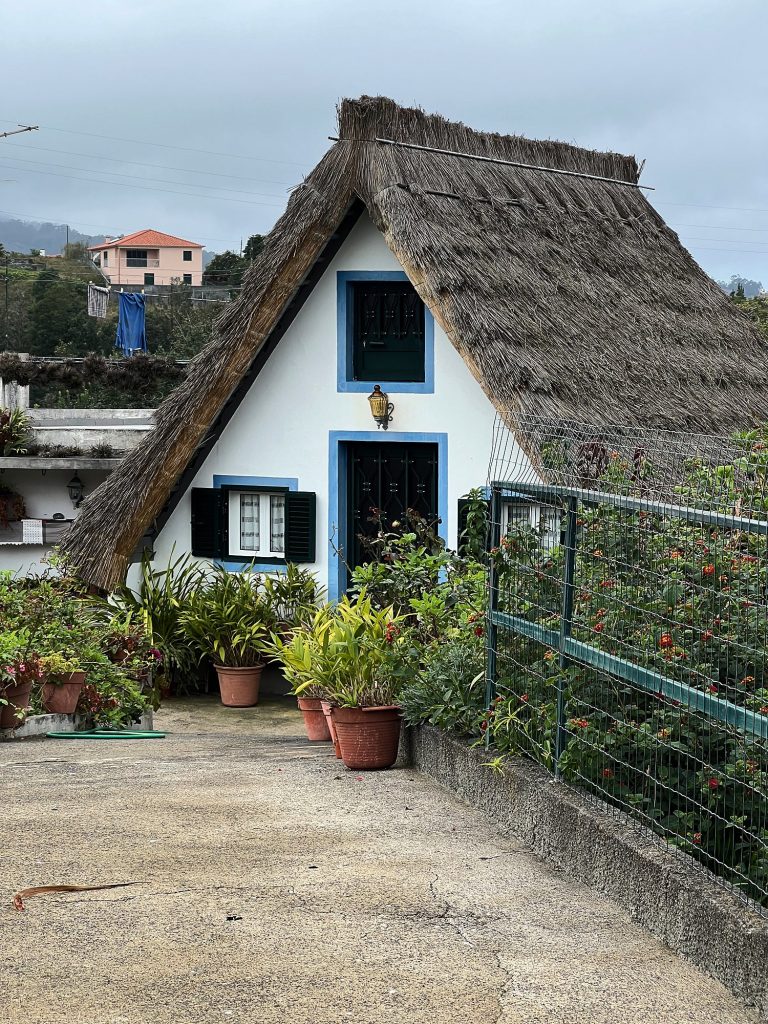
The roof is pitched at about 60° on average, so the rain runs off quickly and the thatch lasts longer. In empena-type houses the roof comes down almost to the ground, hence the triangular silhouette. A typical house measures about 4.6 × 7 m and is 4.4 m high.
The thatch is made from local varieties of wheat (“branco” and “galhoto”) and from rye, tied with wicker and partly replaced every 4–5 years. The grain is harvested by hand so the stalks don’t break. The houses are painted white, red and blue.
What’s inside?
The loft was used to store food and seeds, and the ground floor was divided by a partition into the parents’ and the children’s bedrooms. The kitchen was separate, in a second thatched building. Similar buildings for cattle were called palheiros – they were cowsheds, not homes.
My photos from November 2023 show the inside of one of the houses: a wooden bed with a colourful bedspread, and wicker armchairs under the thatch. I didn’t pay anything to go in.
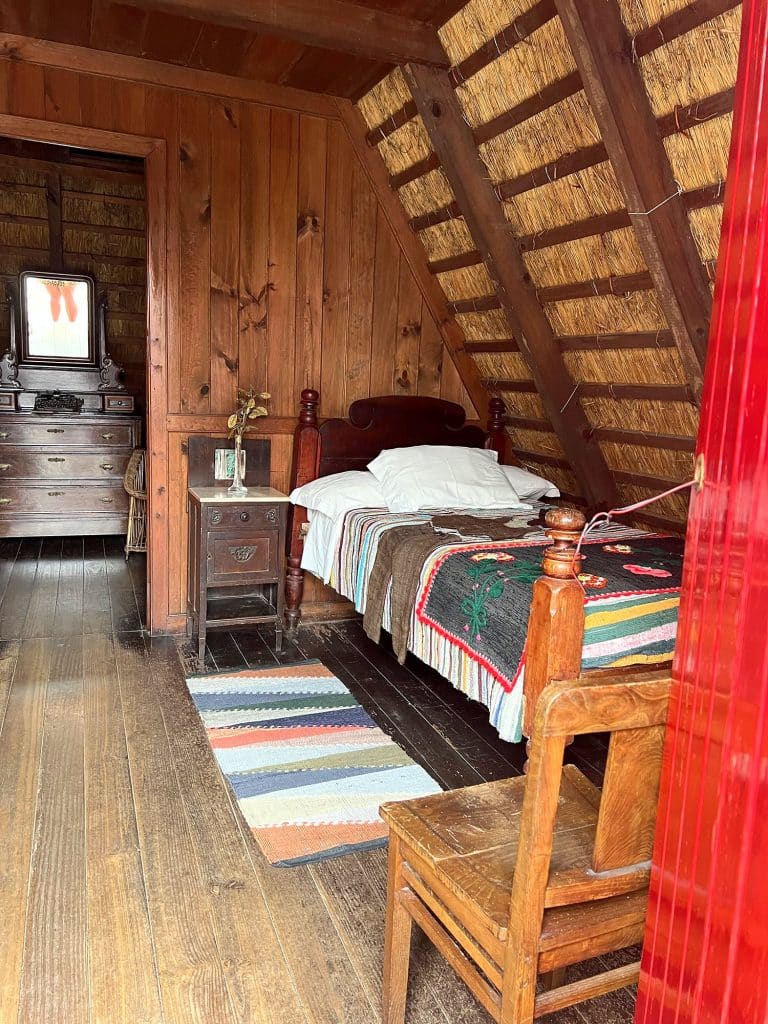
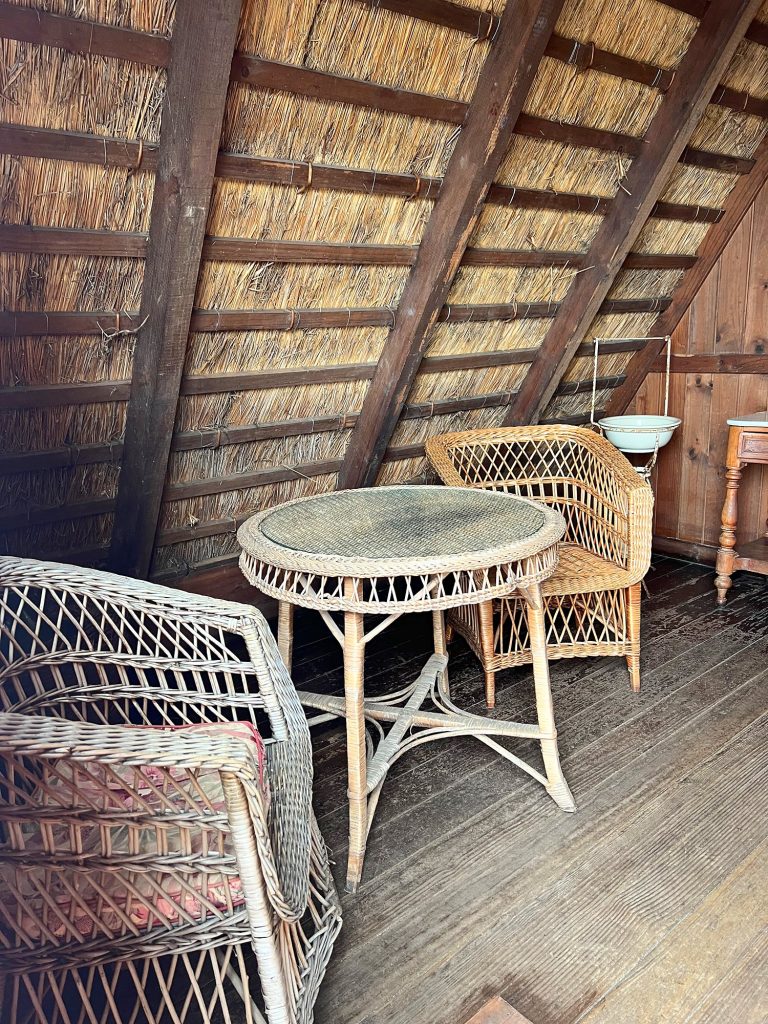
1: Inside a triangular house in Santana, 2: The loft of a thatched house in Santana. Photos: Ewelina Podrez-Siama 2023
How many houses are left?
The list attached to the municipal regulations of 2024 includes 81 houses: 69 in Santana, 10 in São Jorge and 2 in Arco de São Jorge (my count, Regulamento n.º 656/2024). The municipality subsidises owners for new thatch and even grows wheat and rye itself on abandoned fields.
By June 2024 the municipality had supported 38 houses, 34 in Santana and 4 in São Jorge. In April 2025 it signed agreements for another 12, for €68,000.
Where to see the houses
The largest group of houses in one place stands by the town hall (Núcleo de Casas Típicas). The houses contain little shops selling local products and handicrafts, and next to them is a viewpoint over Santana’s fields. No official source mentions an entry fee. According to Visit Madeira, the tourist information point in one of the houses is temporarily closed.
When I was in Santana in the early afternoon, the houses were packed with tourists. For photos without the crowds, come in the morning. You’ll see individual houses all over the municipality. The Casa de Abrigo das Queimadas, at the start of the PR9 trail, still has its original thatch.
Parque Temático da Madeira
The ethnographic theme park is about 400 m from the centre. It opened in 2004 and covers more than 7 ha. It’s open Tuesday to Sunday, 10:00–18:00, and closed on Mondays (Parque Temático da Madeira).
| Ticket | Price |
|---|---|
| adults | €13 |
| children 6–14 and seniors 65+ | €9 |
| children 4–5 | €3 |
Inside there are Santana houses and miniatures of them, animals, a lake with boats, a simulator, craft workshops and bread from a wood-fired oven. Since 2024 there has also been a pavilion about the levadas. The park recommends 2–4 hours for a visit.
The park’s gardens were free for everyone from 2018, and since 2024 only for Madeira residents. In October 2026 visitors could enter the gardens free only on selected Sundays. The park’s website still lists the old bus numbers (56 and 103); today they are 801 and 850.
The Rocha do Navio cable car
The cable car runs down the cliff to a fajã, a flat strip of land above the sea where farmers grow crops. It was built for them. Since 7 May 2026 it has been closed indefinitely for maintenance work. Visit Madeira still lists opening hours as if it were running.
There’s also a steep path down, but nobody officially reports its condition. Off the shore begins the Rocha do Navio marine reserve (since 1997), home to monk seals. From the Miradouro da Rocha do Navio viewpoint you can see the Ilhéu da Viúva islet, which looks like the bow of a ship.
Santana without a car? The triangular houses are a stop on many tours of the north, often combined with Pico do Arieiro. Compare offers and reviews on GetYourGuide.
Nature around Santana
Queimadas and the Levada do Caldeirão Verde (PR9)
The Queimadas forest park is 4 km from the centre, in the laurel forest. The IFCN car park costs €2 per hour, the first 30 minutes are free, and you pay no more than €10 a day (Portaria 48/2026).
This is where the PR9 Levada do Caldeirão Verde trail starts. Since 29 May 2026 only the Queimadas – Caldeirão Verde section has been open: about 6.5 km each way, to a waterfall about 100 m high (IFCN notice, Visit Madeira). The section beyond, to Caldeirão do Inferno, has been closed since at least February 2023. A trail ticket costs €4.50 (how to buy it), and you can check the status on my trail status page.
Pico Ruivo, Levada do Rei and Balcões
10 km from Santana, at Achada do Teixeira, starts the shortest route up Madeira’s highest peak, described in my guide to Pico Ruivo. I cover the almost flat Levada do Rei (PR18) in a separate guide, and the short Vereda dos Balcões (PR11) from Ribeiro Frio in my overview of levada walks in Madeira.
Weather in Santana
Santana gets an average of about 1156 mm of rain a year, on about 119 days (my calculation from DREM data). That’s twice as much as Funchal, which gets 574 mm on 53 days (IPMA normal 1991–2020). The average temperature here is about 16°C, 4°C cooler than in Funchal.
The difference is biggest in summer: in July and August it hardly rains in Funchal, while Santana gets about 25 mm a month. In 2024 and 2025 Santana had the most rainy days in the whole region. Take a rain jacket even in August. You’ll find the forecast on my Madeira weather page.
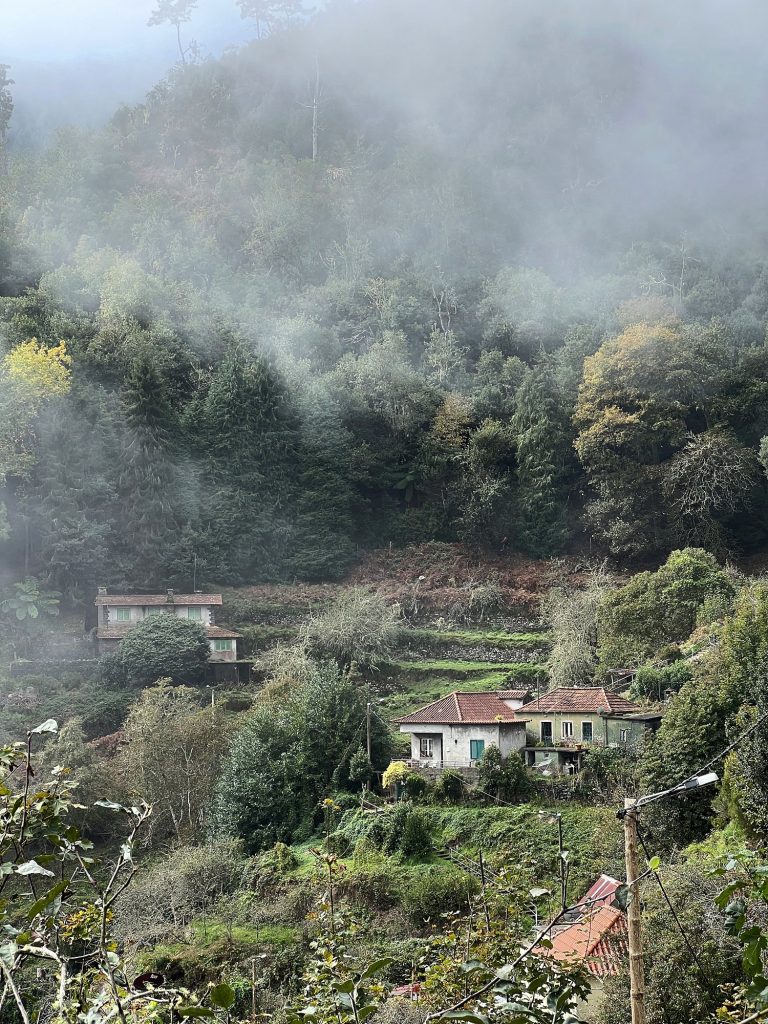
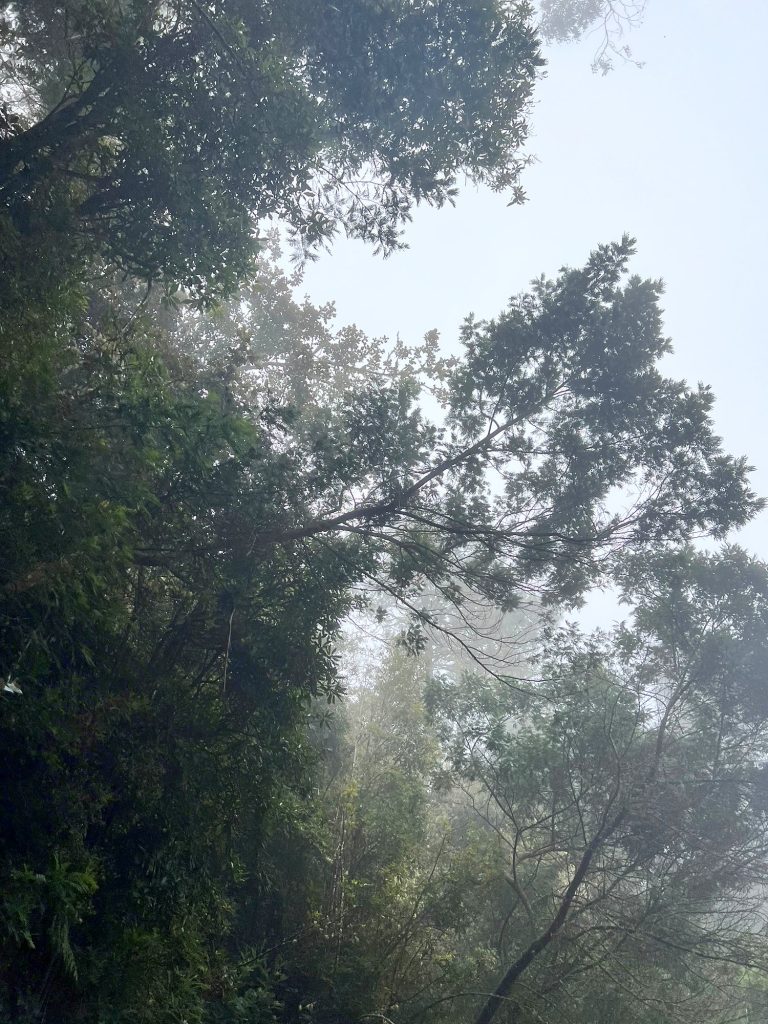
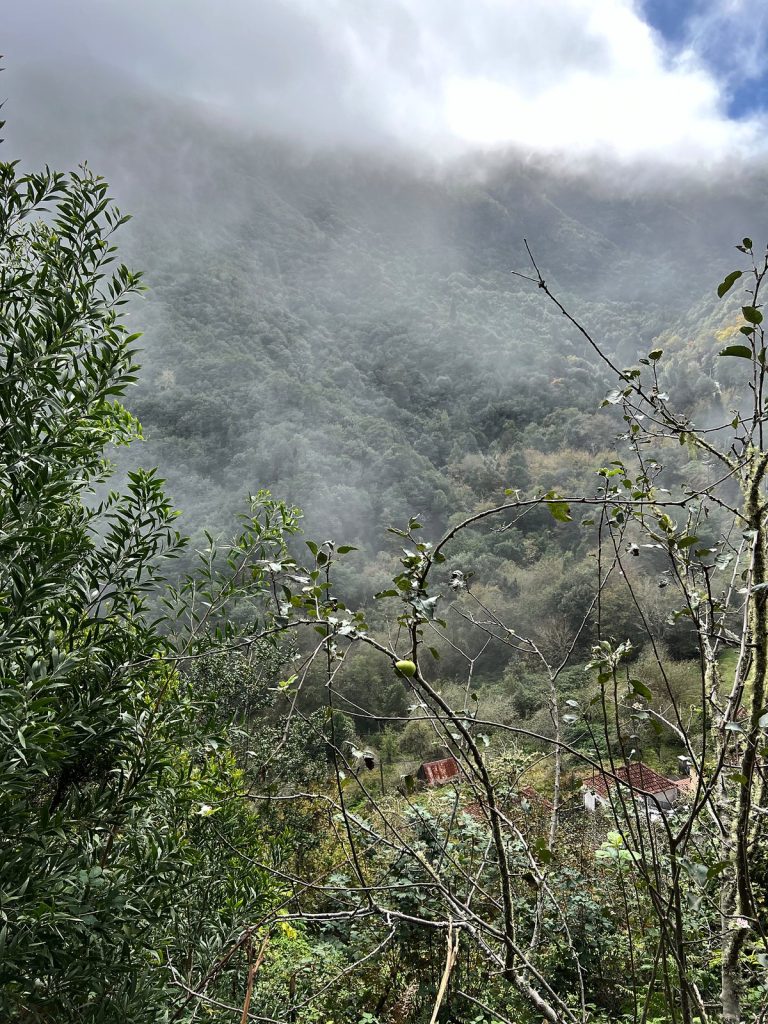
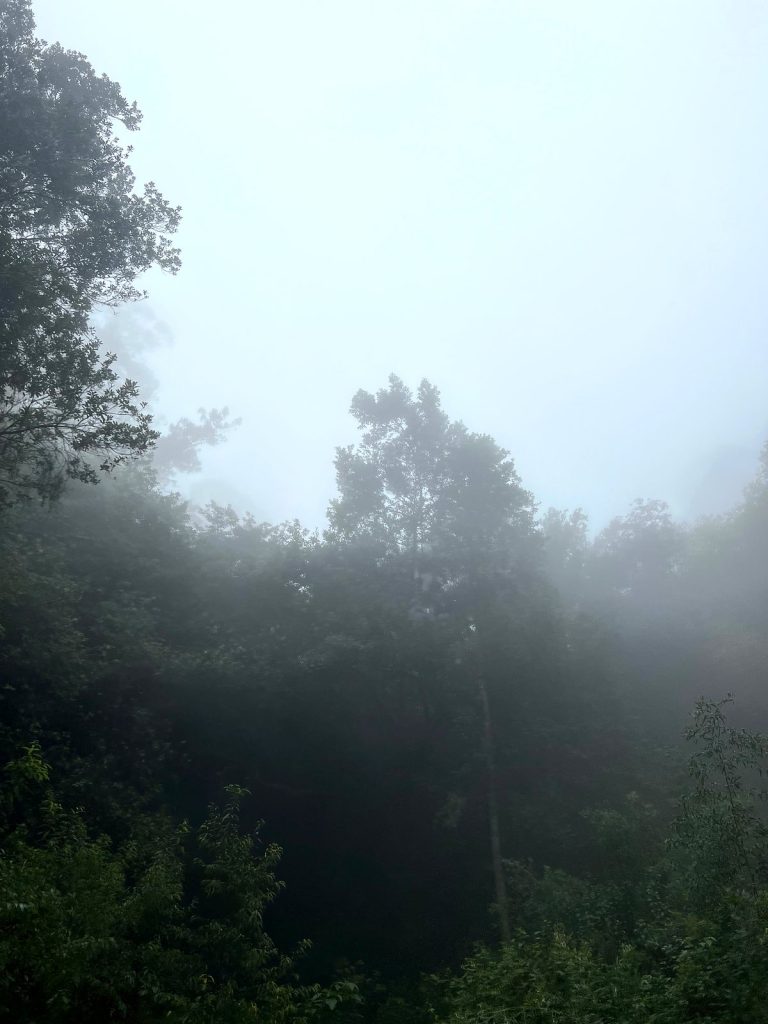
1: A misty valley in the north of Madeira, 2: Forest in the mist in the north of Madeira, 3: Clouds on the slopes in the north of Madeira, 4: Mist between the trees in the north of Madeira. Photos: Ewelina Podrez-Siama 2023
Events in Santana
- Festa dos Compadres in February opens the carnival season in Madeira: a parade, a satirical trial and the burning of giant effigies. In 2026 it took place on 21–22 February, postponed because of elections. There’s no date for 2027 yet; I cover the Funchal carnival in my guide Madeira in February.
- 24 Horas a Bailar: a folk festival on the first weekend of July, in 2026 on 4–5 July (municipal events calendar).
- Smaller festivals: the custard apple (anona) fair in Faial, the lemon fair in Ilha (May), the trout festival in São Roque do Faial (June).
Nearby: Faial, São Jorge and Porto da Cruz
São Jorge has a church from 1761, the largest Baroque church in the region, and in Achadinha there’s a watermill that still grinds maize. From Faial you can see the Penha d’Águia rock, and beyond it lies Porto da Cruz with its steam-powered rum distillery, which I describe in my guide to Porto da Cruz.
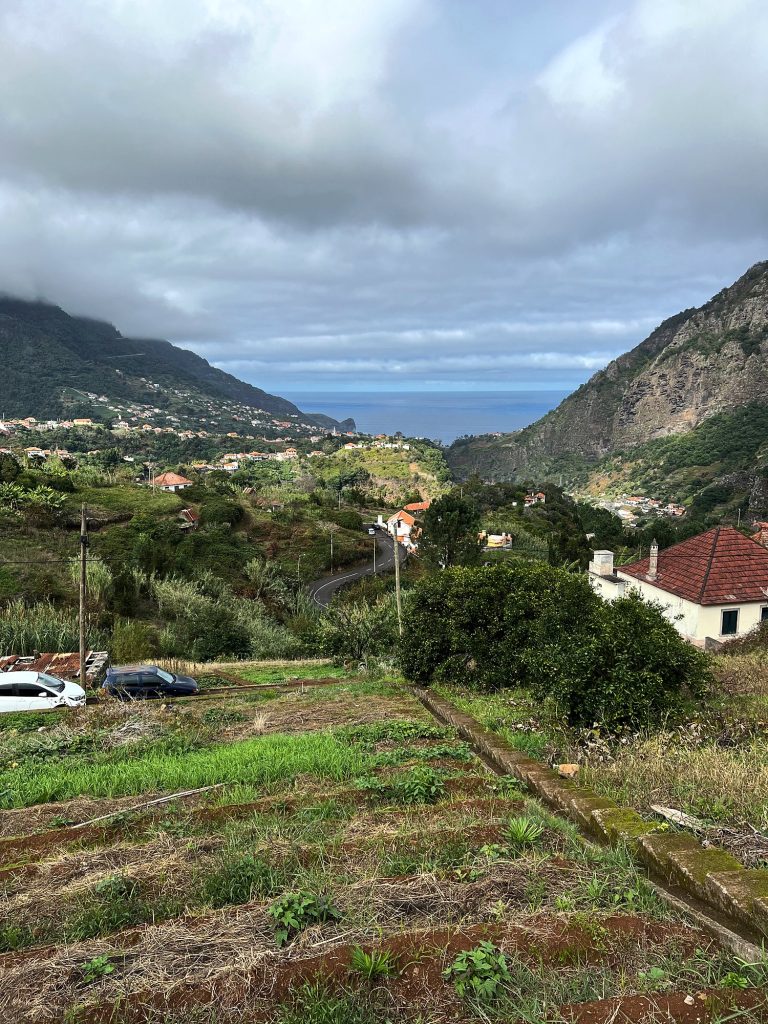
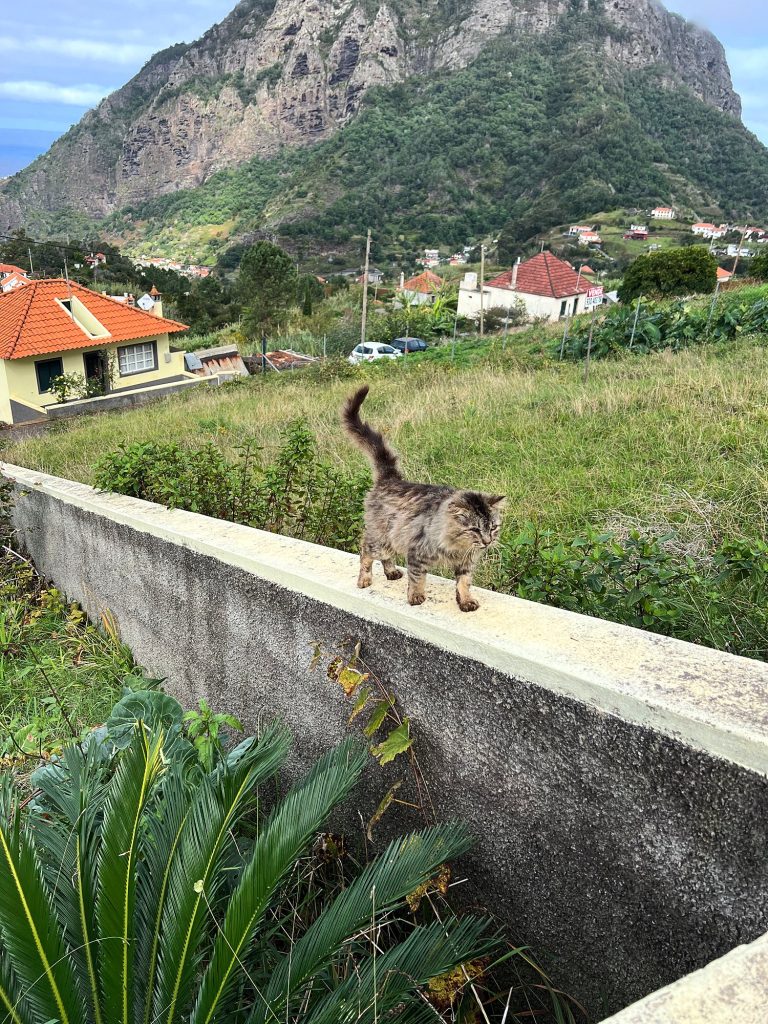
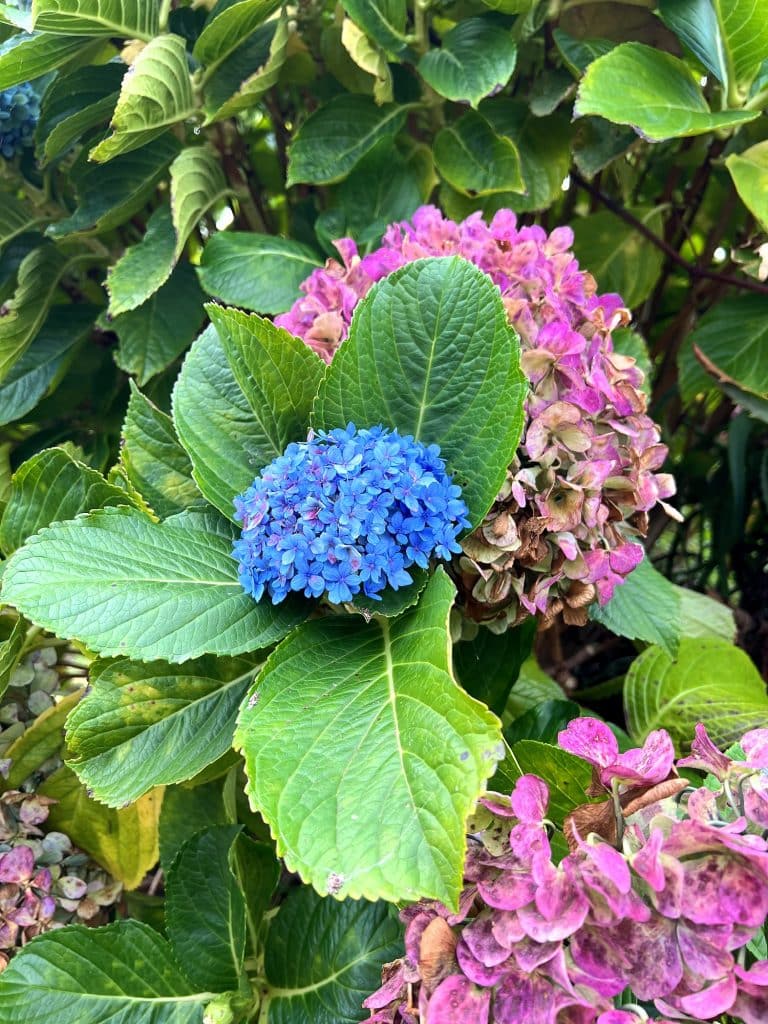
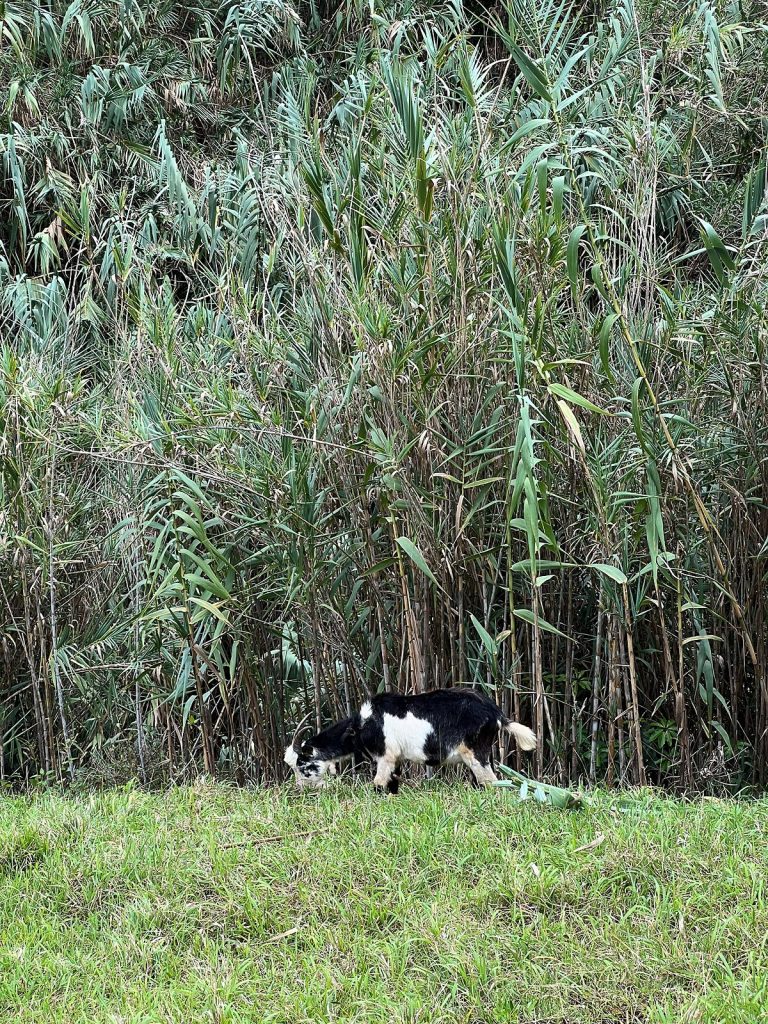
1: A valley in the north of Madeira, 2: A cat on a wall on the north coast, 3: Hydrangeas in the north of Madeira in November, 4: A goat in the north of Madeira. Photos: Ewelina Podrez-Siama 2023
Santana charges a tourist tax: €2 per person per night, from age 13, for a maximum of 7 nights (Santana municipality). I compare areas to stay in my guide where to stay in Madeira.
Santana: frequently asked questions
How much does it cost to visit the houses in Santana?
No official source mentions an entry fee for the group of houses by the town hall. The houses contain little shops selling local products. When I was there in November 2023, I didn’t pay anything to go into a house. The houses in the Parque Temático da Madeira are included in the ticket (€13 for adults).
How do I get to Santana from Funchal?
By car it’s about 39 km through the tunnels on the VR1 and VE1, about 45–60 minutes. By bus, lines 801, 850 and 875 run there: from about 1 hour (the 850 at 16:00 and 18:00) to almost 2 hours (the 801 via Poiso). A ticket from the driver costs €2.65.
Why are the houses in Santana triangular?
The thatched roof is pitched at about 60°, so the rain runs off quickly and the thatch lasts longer. In empena-type houses the roof comes down almost to the ground, hence the triangular shape.
Is the Rocha do Navio cable car running?
No. Since 7 May 2026 it has been closed indefinitely for maintenance work. Check the Santana municipality’s announcements before you go.
How much is the Parque Temático da Madeira?
An adult ticket costs €13, children aged 6–14 and seniors 65+ pay €9, and children aged 4–5 pay €3. The park is open Tuesday to Sunday, 10:00–18:00, and parking is free.
Is PR9 to Caldeirão do Inferno open?
No. Since 29 May 2026 only the Queimadas – Caldeirão Verde section has been open, about 6.5 km each way. The section beyond, to Caldeirão do Inferno, has been closed since at least February 2023.
Data checked 17 October 2026.
Sources I used (35)
- Santana municipality – history; heritage; parks and museums; viewpoints; INE – 2021 census
- Santana Madeira Biosfera – casas de colmo; biosphere reserve; UNESCO – Santana Madeira; Rocha do Navio reserve; events
- Regulamento n.º 656/2024; Santana municipality: 6 years of restoring the houses, 2025 agreements, 2026 subsidies, cable car closed, 7 May 2026
- Visit Madeira: Santana houses, Núcleo de Casas Típicas, information points, Rocha do Navio cable car, PR9
- Parque Temático da Madeira; DNoticias 2 August 2024; DNoticias 7 October 2026; levada pavilion
- SIGA/CAM – Rede Santana timetable; Portaria 48/2026 – IFCN fees; IFCN – trails; IFCN notice on PR9; DNoticias 28 May 2026
- DREM – precipitation 2000–2025; DREM – 2025 data; IPMA – climate normal for Funchal
- Festa dos Compadres 2026; 24 Horas a Bailar 2026; Santana tourist tax
A car from the airport: compare car hire prices at Madeira Airport (FNC) on DiscoverCars.
One comment in this post