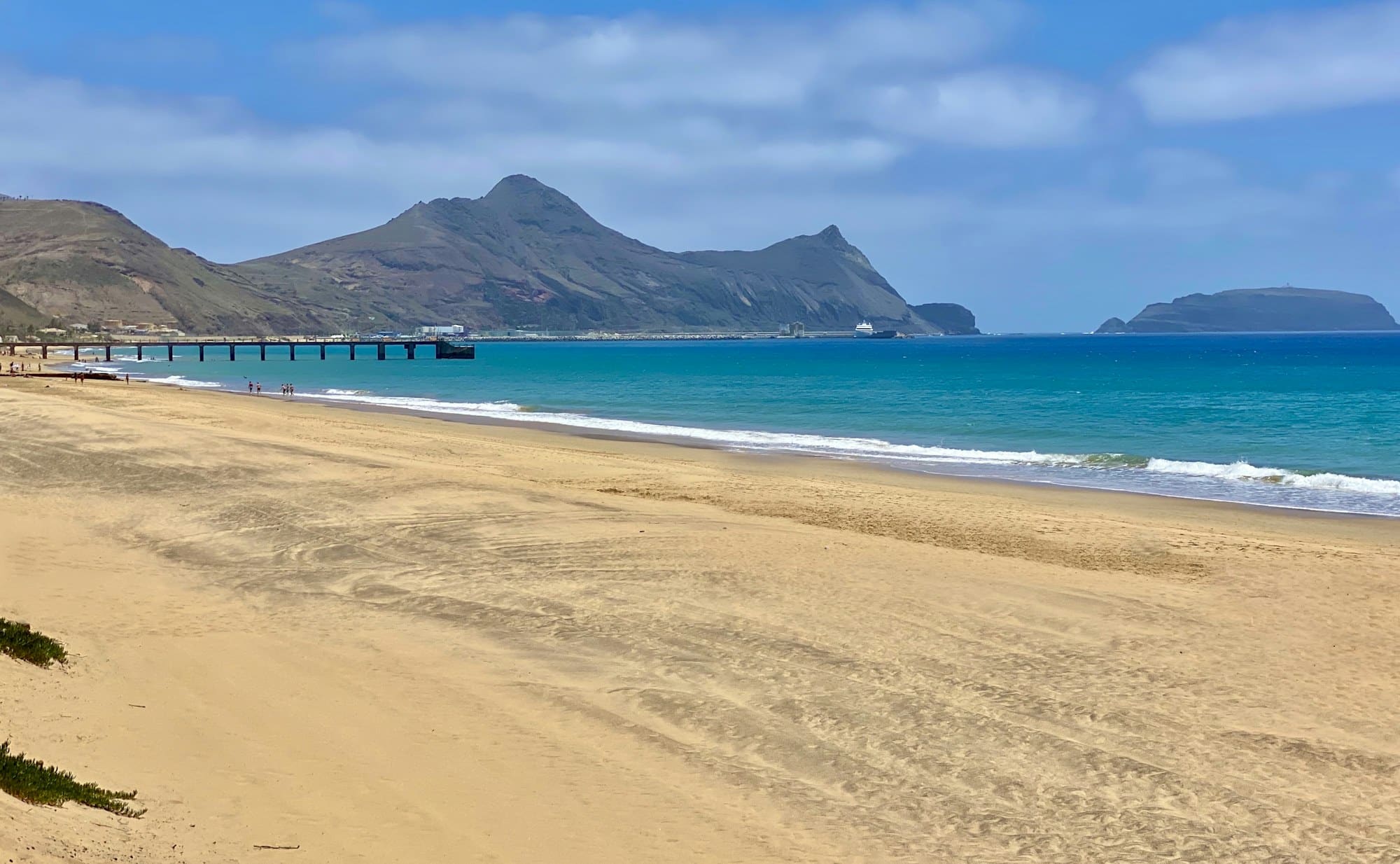
- Golden sand on Madeira itself exists only in Calheta and Machico – and even there it arrived by ship from North Africa. Porto Santo has a natural golden beach, 9 km long.
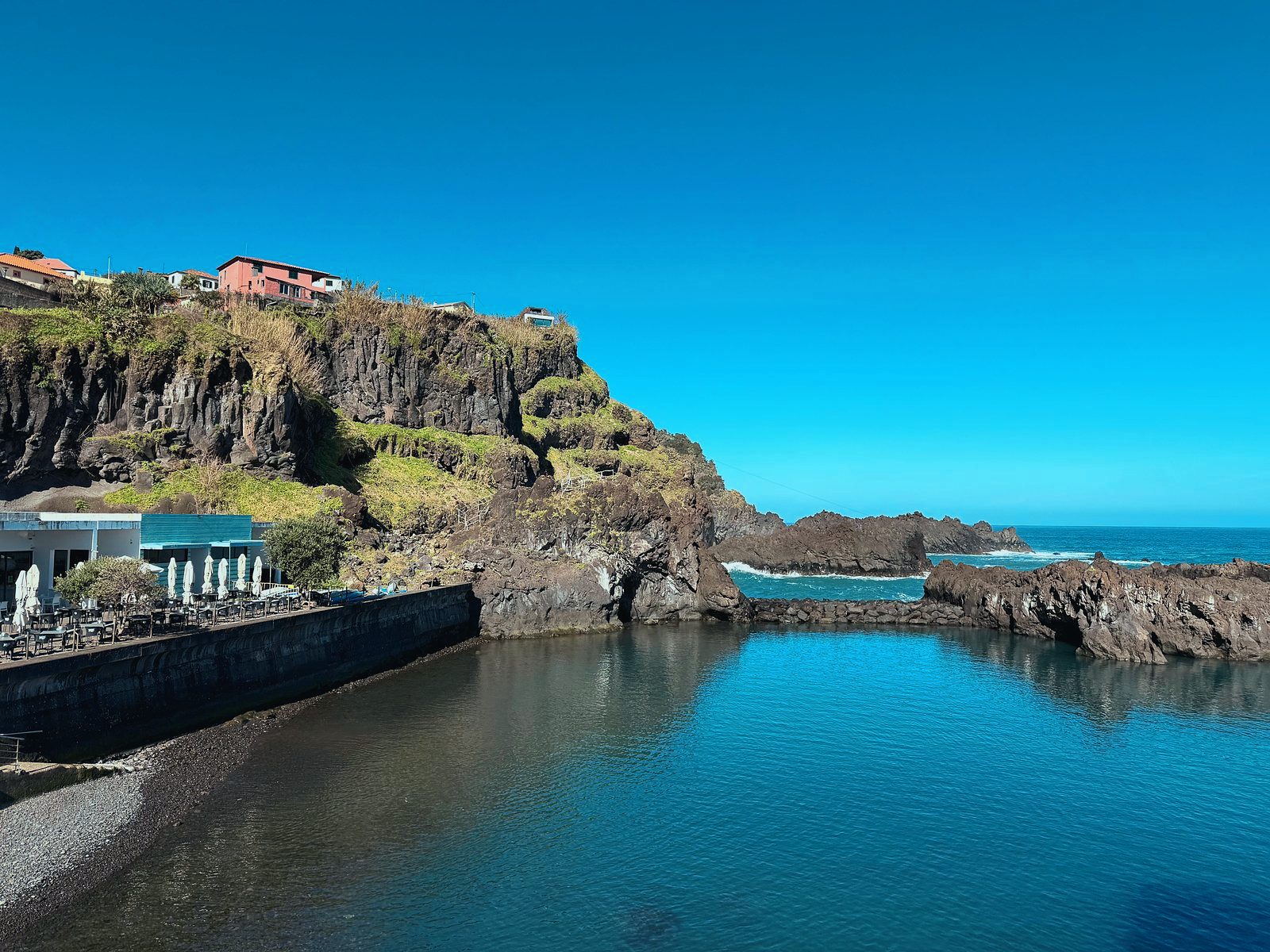
- The rest of the coast is pebbles, black volcanic sand (Seixal, Porto da Cruz) and pools in solidified lava (Porto Moniz, the bathing complexes in Funchal).
- Lifeguards in 2026: in Funchal from 1 June to 15 September, in Porto Moniz from 15 April to 15 October, on Porto Santo until 31 October. Out of season the beaches are unguarded.
- Water: from about 18°C in March to about 24°C in September.
- Prices: the beaches are free. The bathing complexes in Funchal cost €6 and are open all year, the pools in Porto Moniz €3.
Madeira’s beaches are nothing like the Canaries. The island is volcanic and drops into the ocean in steep cliffs, so instead of wide sandy beaches it has pebbly coves, black sand and pools carved out of solidified lava. The golden sand had to be shipped in. Here I describe 12 beaches and bathing spots in Madeira and on Porto Santo: what they look like, what they cost, when lifeguards are on duty and how to get there.
The stretch of coast I know best runs between the Lido and Câmara de Lobos. I walked it along the promenade past Praia Formosa in February 2025 with my mixed-breed dog Tesla, and once more a year later. I saw the black beach in Seixal in February 2026 on a jeep tour of the west of the island, which began with a morning walk by the pebbly bay in Ponta do Sol.
Madeira’s beaches in numbers
Are there sandy beaches in Madeira?
There are, but you can count them on the fingers of one hand. The first artificial golden-sand beach was built in Calheta in 2004, the second in Machico in 2008. Visit Madeira says the sand comes from Morocco, and according to reports from 2008 the ships brought it from the port of Laayoune in Western Sahara. Madeira’s natural sand is dark: black and volcanic in Seixal, in Porto da Cruz (Praia da Alagoa) and at Areeiro in Funchal, copper-coloured at Prainha near Caniçal. Praia Formosa is pebbles, partly covered with black sand in season. In winter the sea takes the sand away, and in May the council spreads it out again.
If you dream of a long barefoot walk on golden sand, take the ferry to Porto Santo. There you’ll find 9 km of natural beach, 2 h 15 min by ferry from Funchal.
| Beach | Type | Lifeguards 2026 | Blue Flag | Entry |
|---|---|---|---|---|
| Praia Formosa (Funchal) | pebbles, black sand in season | 1 Jun–15 Sep | yes | free |
| Lido and Ponta Gorda (Funchal) | seawater pools | 1 Jun–15 Sep | yes | €6 |
| Garajau (Caniço) | pebbles, cable car down | 15 Jun–15 Sep | no | free, cable car paid |
| Reis Magos (Caniço) | pebbles and a concrete sun deck | 1 Jun–30 Sep | yes | free |
| Machico (Banda d’Além) | golden sand, imported | 16 Jun–27 Sep | yes | free |
| Prainha (Caniçal) | natural copper-coloured sand | 30 Jun–27 Sep | yes | free |
| Porto da Cruz | black sand and pools | none | no | beach free, pools €1.50 |
| Calheta | golden sand, imported | 29 Jun–30 Sep | yes | free |
| Ponta do Sol | pebbles | 10 Jun–14 Sep | no | free |
| Seixal | black sand and pools | 1 Jun–30 Sep | no | free |
| Porto Moniz | lava pools | 15 Apr–15 Oct | yes | €3 (free pools next door) |
| Porto Santo | 9 km of golden sand | until 31 Oct (3 sections) | yes (3) | free |
Beaches in Funchal
Praia Formosa
The capital’s biggest beach stretches for about 2 km west of the Lido hotel zone. It is made of pebbles, partly covered with natural black sand from spring to autumn. Entry is free, there are showers, toilets, bars, a playground and a car park, and the beach has lifeguards from 1 June to 15 September. Formosa has a Blue Flag and is one of six beaches in the region certified “Praia Acessível” (accessible beach): people with disabilities can use an amphibious chair, a beach wheelchair and assisted bathing. A sunbed costs €2.80.
From Praia Formosa the seafront promenade takes you to Câmara de Lobos in about 30 minutes on foot. From central Funchal, buses 043 and 001 will get you there. In heavy swell, when the Harbour Master’s Office issues a warning, Frente MarFunchal closes the access points to the sea, as it did in January 2026.
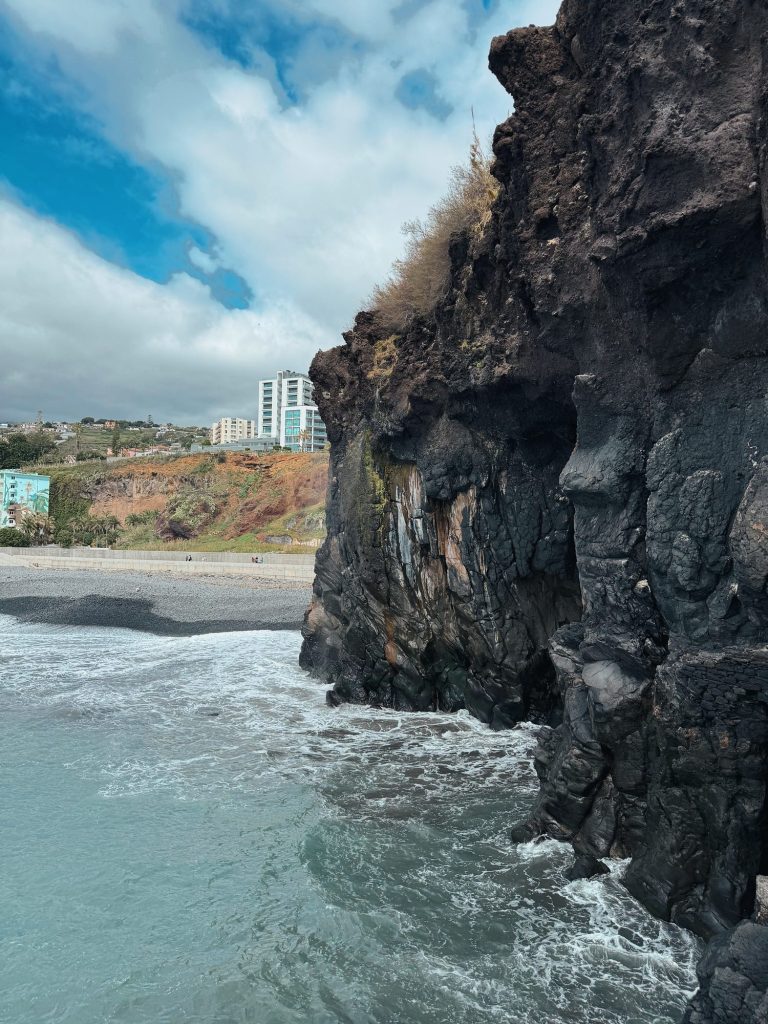
Bathing complexes with pools: Lido, Ponta Gorda, Barreirinha
In Funchal the “complexos balneares” are more popular than the beaches. These are bathing complexes with seawater pools, sunbeds, showers and ladders that take you straight down into the ocean. They are run by the municipal company Frente MarFunchal and open all year, and in 2026 entry costs €6 (young people aged 7 to 17 pay €2, children up to 6 go free). The senior discount, down to €2, applies only to pensioners in the Portuguese system.
- Lido (on the promenade in the hotel zone): a large pool, children’s pools with a slide, access to the sea, a bar and a restaurant. Winter hours 9:00–18:00.
- Ponta Gorda (Poças do Governador): two pools and a tidal pool, a big sun deck and, in summer, a diving platform out at sea. Winter hours 9:30–18:00.
- Barreirinha (Zona Velha, beyond the São Tiago fort): no pools, but a sun deck and access to the sea below the cliff – just right for snorkelling. Winter hours 9:30–17:30.
- Doca do Cavacas (in the west, by Ponta da Cruz): natural lava pools with a view of Cabo Girão. Also €6, but no Blue Flag.
Lido, Ponta Gorda and Barreirinha have a Blue Flag, and lifeguards are on duty there from 1 June to 15 September. Right next to the Lido is the free Lido Poente, with showers and access to the sea, but no lifeguards.
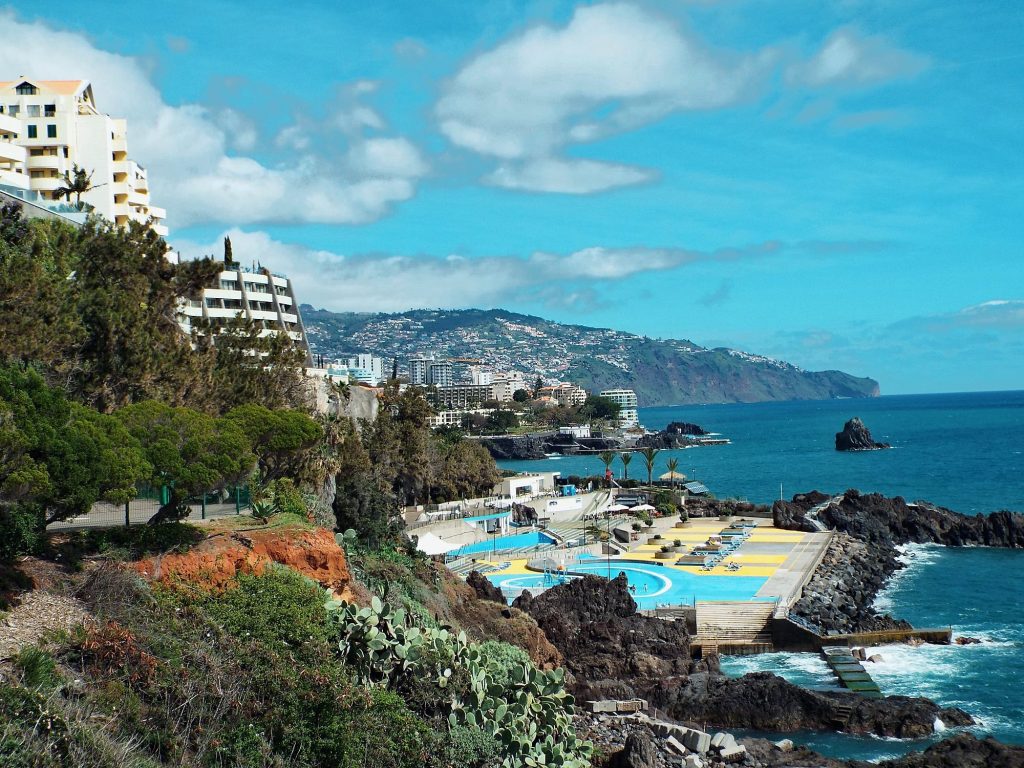
Praia de São Tiago and Almirante Reis
In the Zona Velha (Old Town), below the yellow São Tiago fort, lies the small, pebbly Praia de São Tiago with fishing boats, showers and a bar. Entry is free and there are no lifeguards. I was here with Tesla and nobody minded, so it’s a good spot if you’re travelling with a dog. I write more about that in my guide Madeira with a dog. The neighbouring Praia do Almirante Reis still turns up in guidebooks, but it hasn’t been an official bathing area since 2022, because it lies within the port zone.
Câmara de Lobos
The pebbly beach in the fishing bay of Câmara de Lobos is more a backdrop for photos of the colourful boats than a place to swim. It isn’t an official bathing area, and the nearby lifeguarded Praia do Vigário had a temporary swimming ban in May 2026 because of polluted water.
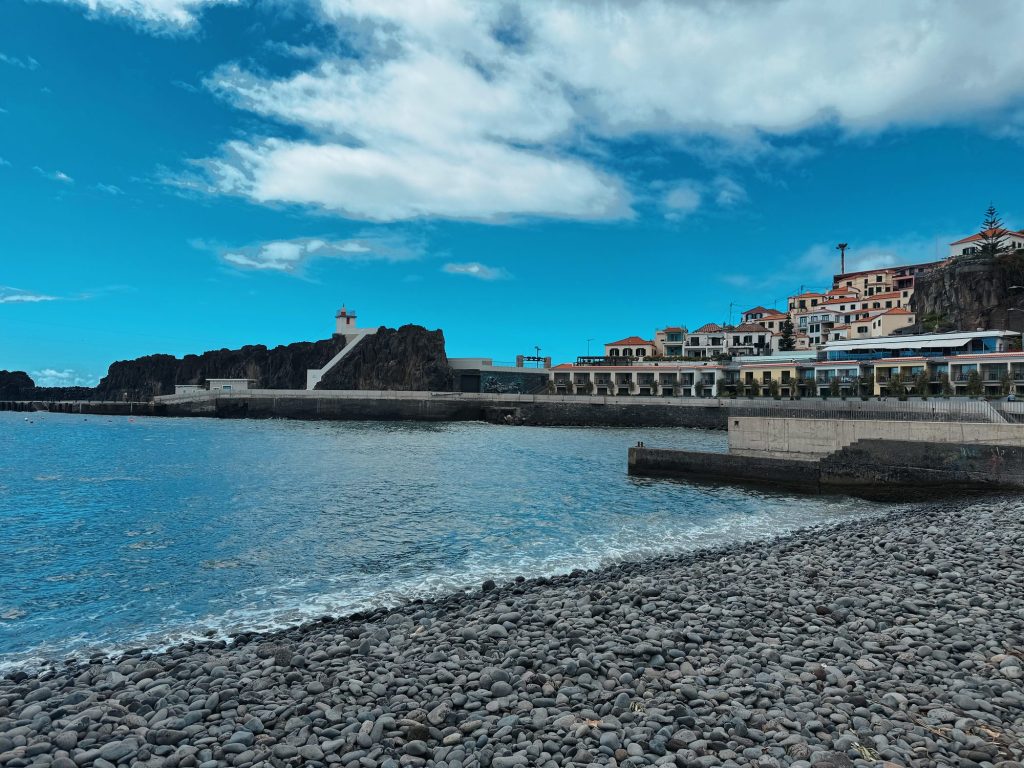
Beaches in the east of Madeira
Garajau: a beach with a cable car
Below the Cristo Rei (Christ the King) statue in Caniço, at the foot of the cliff, lies the pebbly Garajau beach. Around it stretches a marine reserve that divers love. You can ride down in the cable car, which has been running since 2007 (summer 10:00–20:00, winter 10:00–18:00), or walk down a steep road. On the beach there is a bar, toilets, changing rooms and a diving centre. The beach has lifeguards from 15 June to 15 September, but no Blue Flag. From Funchal it’s about 10 minutes by car.
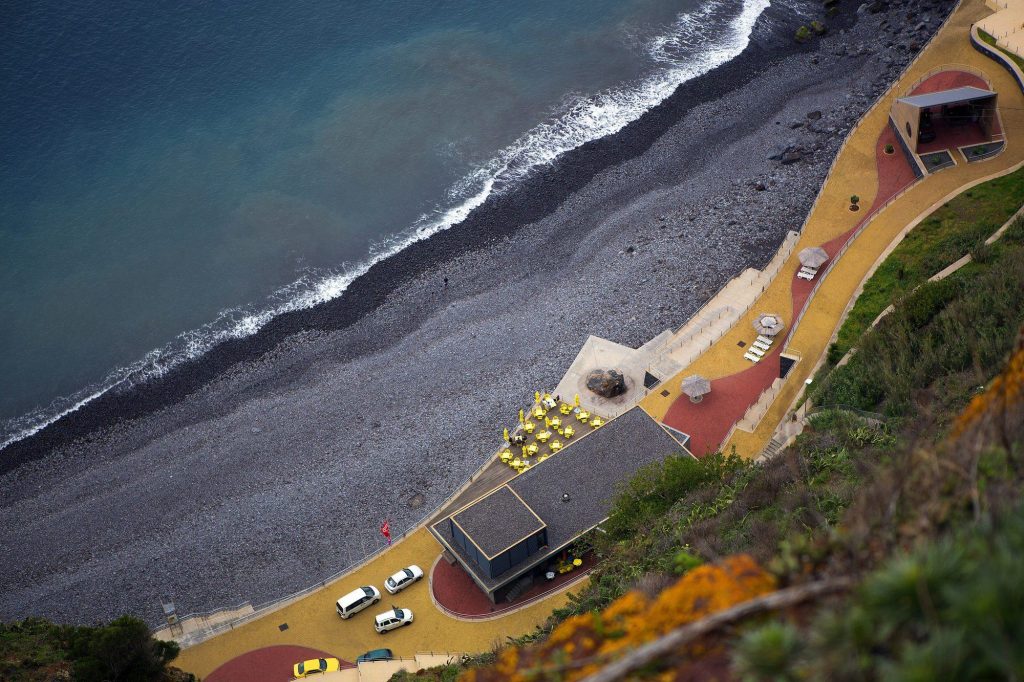
Reis Magos
In Caniço de Baixo you’ll find a pebbly beach with a concrete sun deck, a jetty, a restaurant, sunbeds and toilets. It has a Blue Flag, and from 1 June to 30 September lifeguards watch over its eastern part. Bus 556 runs here from Funchal.
Machico: golden sand near the airport
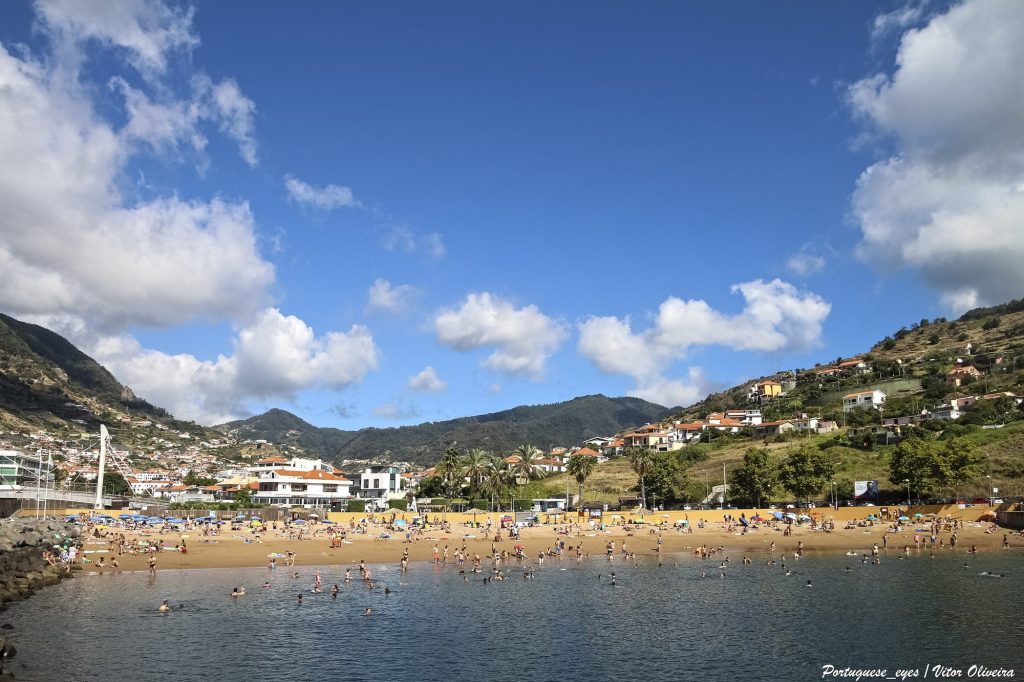
Praia de Machico, officially Banda d’Além, is a golden-sand beach of about 70 × 100 m, opened in 2008. There are cabins, showers, toilets and boardwalks, and for people with reduced mobility also a shaded area and an amphibious wheelchair (“Praia Acessível” certification). The beach has a Blue Flag and lifeguards from 16 June to 27 September. From Funchal it takes about 25 minutes by car or bus 701. The airport is close by, so it’s a good idea for the first or last day of your holiday. Next to it lies the pebbly Praia de São Roque.
Prainha: the only natural light sand
Little Prainha near Caniçal is the only beach in Madeira with natural, copper-coloured sand of volcanic origin. It hides in a cove below the rocks, on the way to the Ponta de São Lourenço peninsula. It has had a Blue Flag since 2025, and the council has added changing rooms and showers. The lifeguard season here runs from 30 June to 27 September. Bus 702 will get you there, and the beach is easy to combine with the PR8 Ponta de São Lourenço trail.
Porto da Cruz: black sand and pools
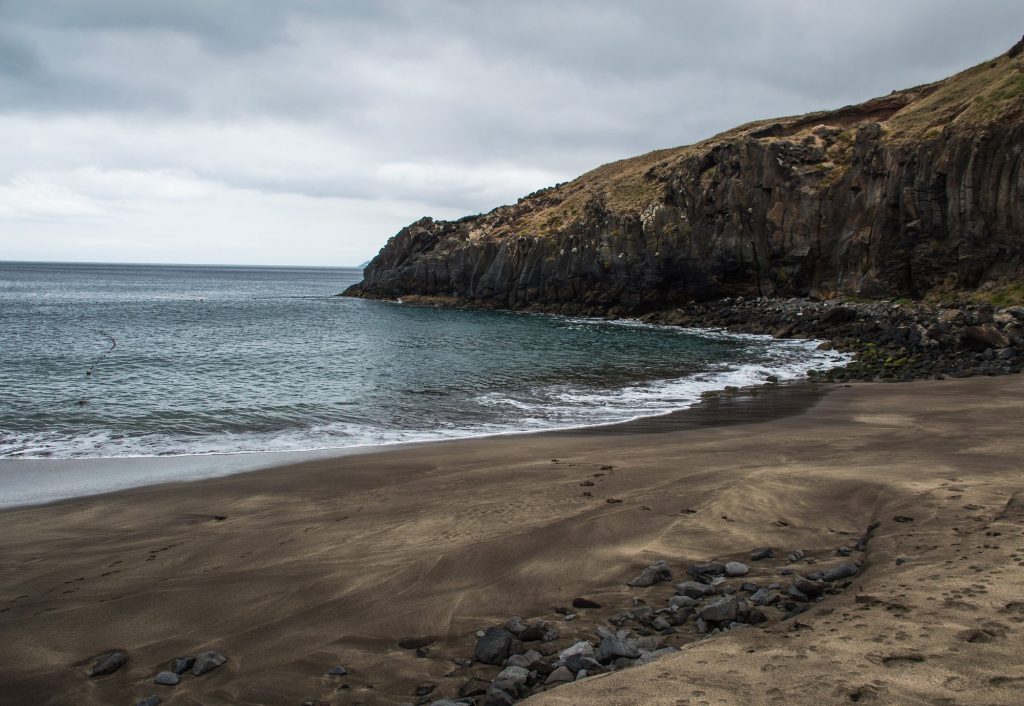
On the north coast, below the Penha d’Águia rock, Praia da Alagoa tempts you with natural black sand and waves that surfers have taken a liking to. Next to it is a bathing complex with two pools: in 2026 it opened on 23 June, and entry costs €1.50 (children up to 12 €0.75). There are no lifeguards either on the beach or at the pools. You can read more about the village in my Porto da Cruz guide.
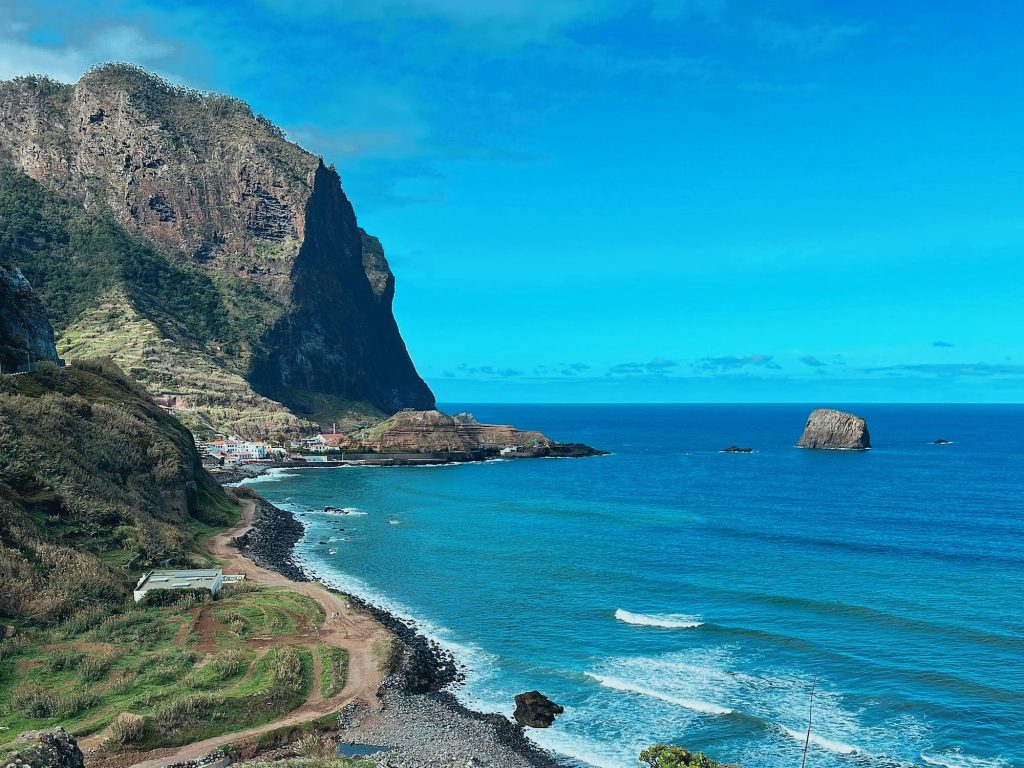
Beaches in the west of Madeira
Calheta: the most “holiday-like” beach
Madeira’s first artificial beach was built here in 2004. It consists of two golden-sand coves sheltered by breakwaters, with a hotel on one side and a square full of bars on the other. Entry is free. There are showers, toilets, a first-aid post, sunbeds, parasols and three car parks, and behind the breakwaters the water is often calmer than in the open sea. The beach has a Blue Flag, although lifeguards only arrive on 29 June and stay until 30 September. You reach the sand down a flight of steps. Next door is the pebbly Praia do Calhau, quieter on hot days. From Funchal it’s 30–40 minutes by car, or bus 380, which leaves at 10:00.
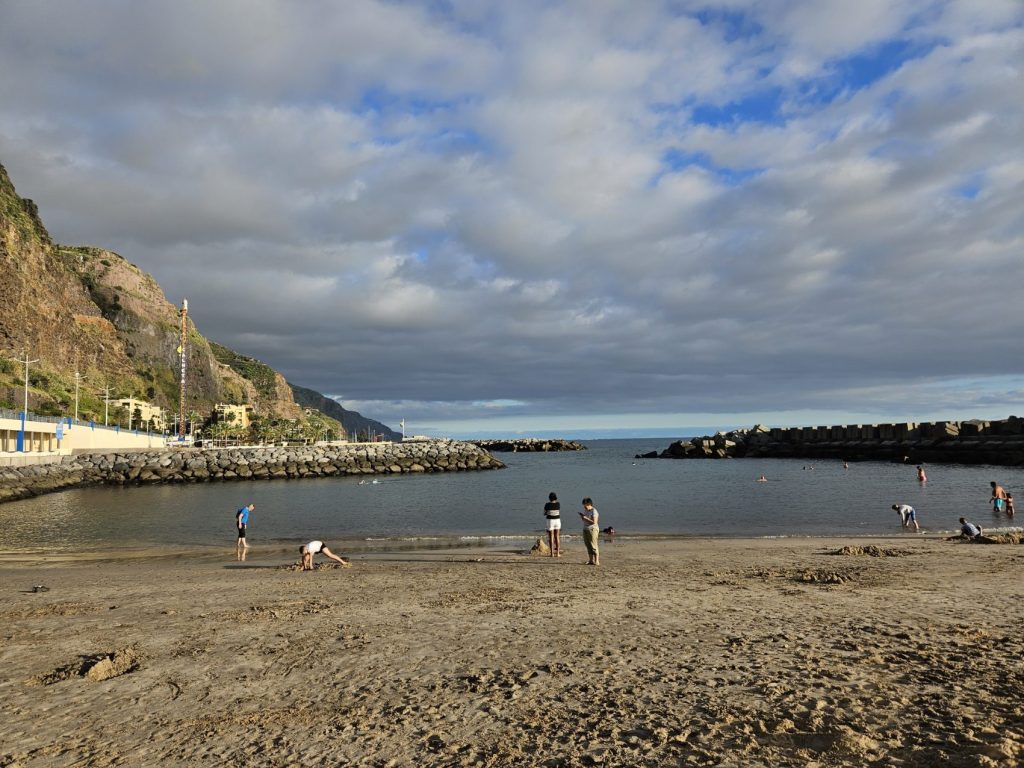
Ponta do Sol and Praia dos Anjos
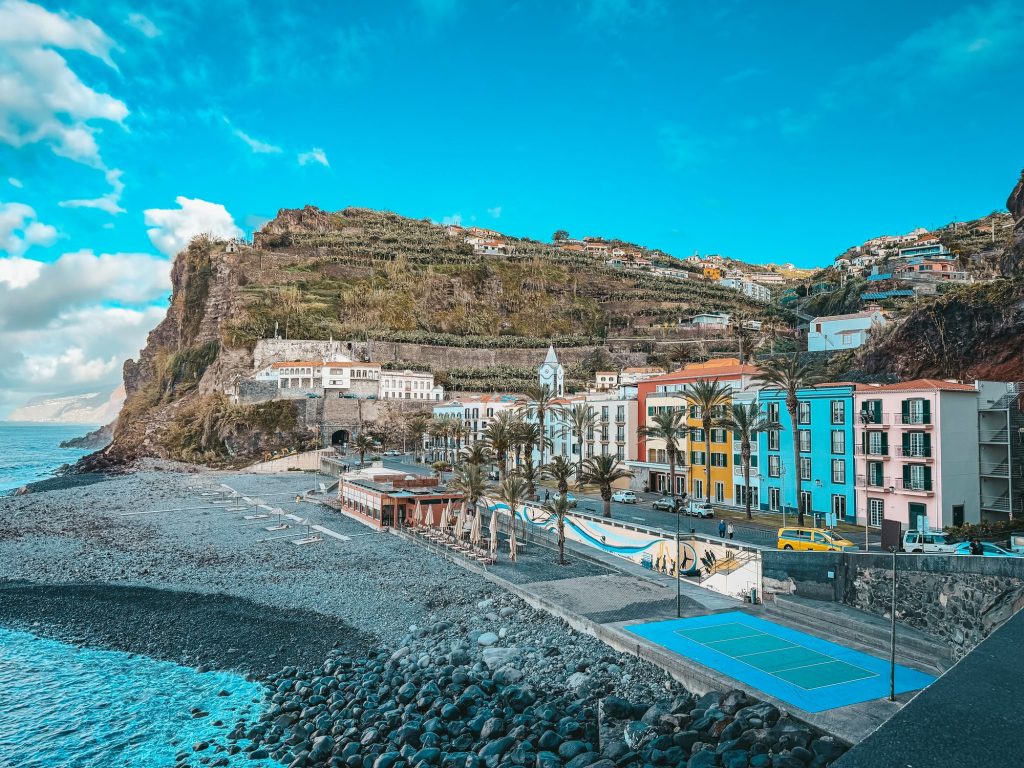
In Ponta do Sol, below colourful townhouses, lies a pebbly beach about 160 m long, with changing rooms, a bar and a summer library. The beach has lifeguards from 10 June to 14 September. Not far away, in the parish of Canhas, is Praia dos Anjos, with basalt pebbles and black sand, a seasonal bar and wooden platforms from which you step into the sea. There are no lifeguards there. Don’t go near the Cascata dos Anjos waterfall: access to it is prohibited.
Jardim do Mar and Paul do Mar
These two villages tucked below the cliffs in the west have pebbly beaches without lifeguards. They mostly attract surfers, and Jardim do Mar hosts international competitions. For a calm swim you’re better off in Calheta, a few kilometres away.
Beaches in the north of Madeira
Seixal: black sand below green slopes
The beach by the harbour in Seixal has black volcanic sand, with steep green slopes criss-crossed by farming terraces rising above it. Entry is free, there are showers, a bar and kayak hire, and lifeguards are on duty from 1 June to 30 September. Right next to it are the free natural pools of the Clube Naval (10:00–19:00, no lifeguards). When the swell builds on the north coast, the lifeguards close the bathing area, so check the IPMA warnings (Portugal’s weather service) before you set off.
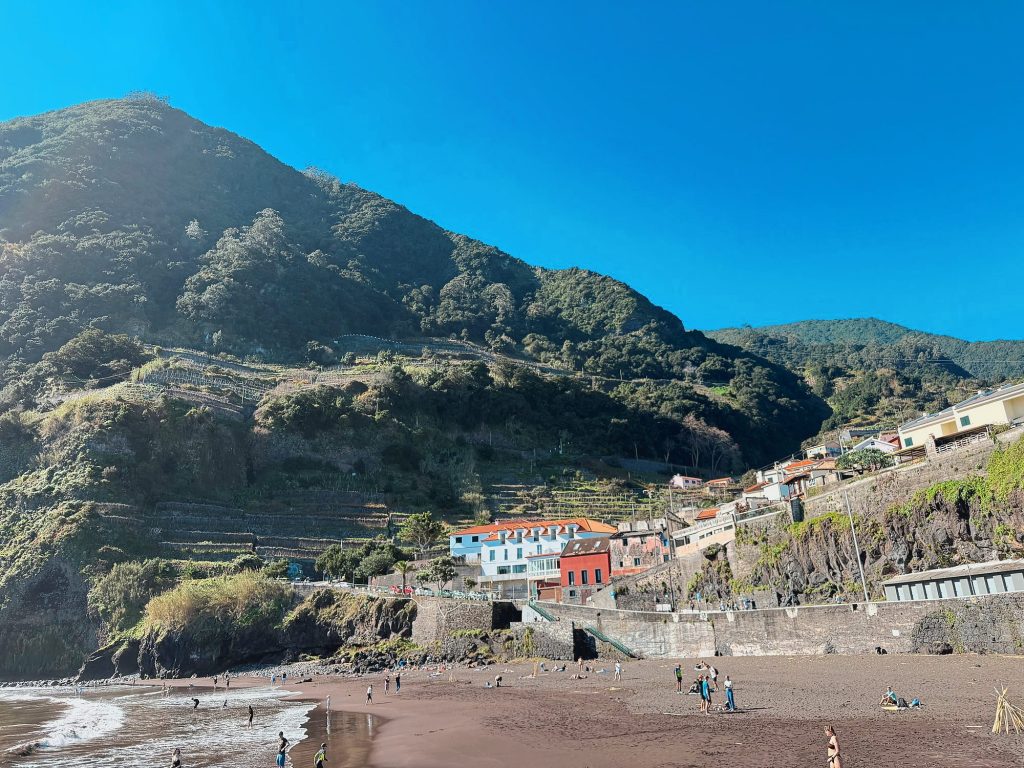
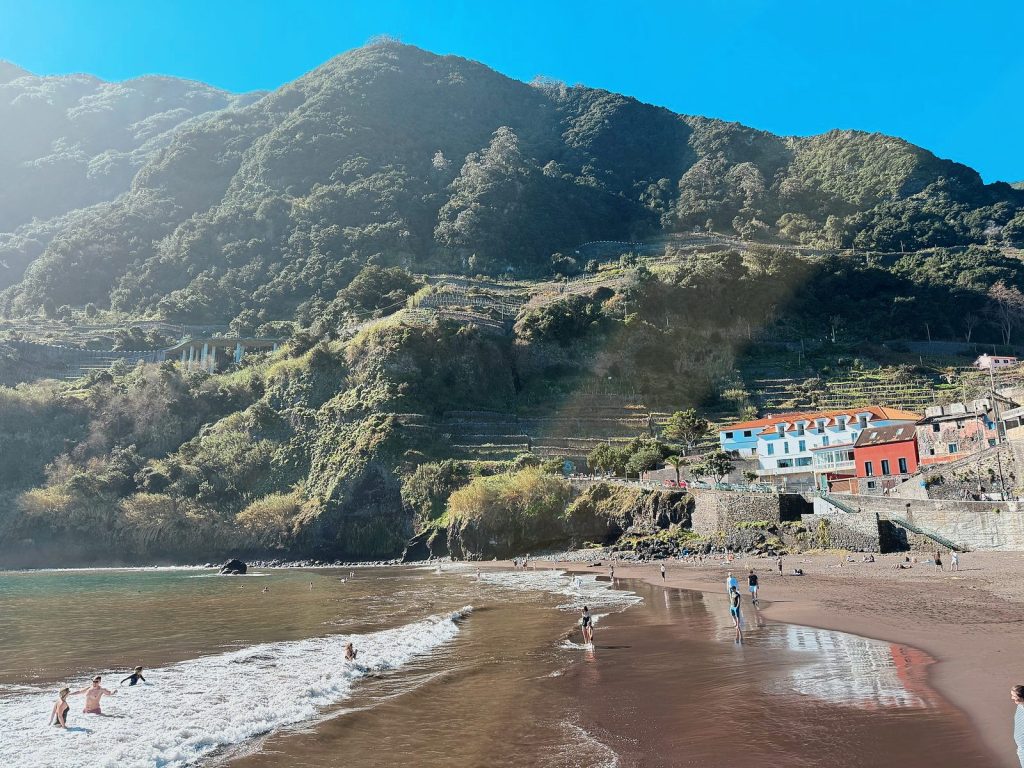
1: The beach in Seixal, February 2026, 2: The beach in Seixal below the green mountain, February 2026. Photos: Ewelina Podrez-Siama
Porto Moniz: pools in solidified lava
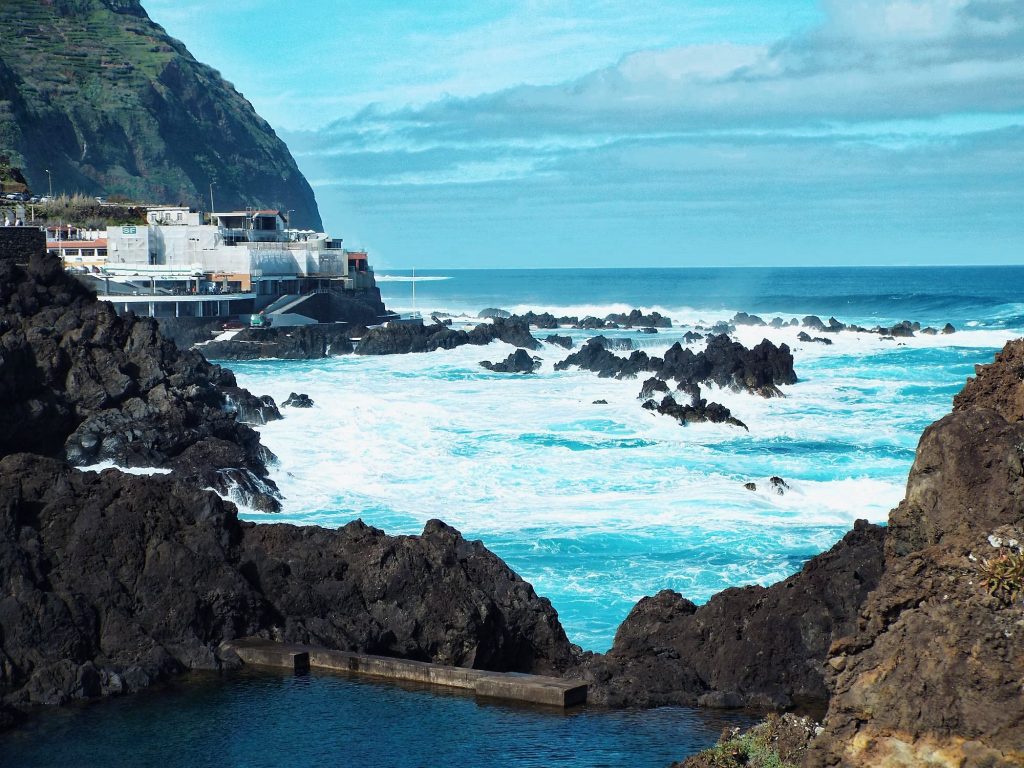
The natural pools in Porto Moniz are Madeira’s most famous bathing spot. Entry to the municipal complex costs €3 (from age 4, concession €1.50). The pools are open all year (winter 9:00–17:00, summer 9:00–19:00), the lifeguards here stay longer than anywhere else on the island, from 15 April to 15 October, and the Blue Flag has flown over them for the 31st year in a row. Next door are free pools by the aquarium, without changing rooms or toilets. From Funchal it takes about an hour by car or 3–3.5 hours by bus.
Porto Santo: 9 km of golden sand
The archipelago’s only long, natural golden beach is on the neighbouring island and runs for 9 km, from Vila Baleira to Ponta da Calheta. In 2026 three of its sections – Fontinha, Cabeço da Ponta and Ribeiro Salgado – have a Blue Flag and lifeguards until 31 October. The Lobo Marinho ferry takes about 2 h 15 min from Funchal. A return ticket costs €72.02 from April to September and €58.90 in the other months, plus a fuel surcharge. In January the ferry stops for a few weeks of maintenance. You’ll find the timetable, prices and a plan for your day on the island in my Porto Santo guide.
When can you swim in Madeira?
The bathing season in Madeira doesn’t start on the same day everywhere. Each bathing area has its own dates, which the regional government announces every year in a regulation. In 2026 the season started earliest in Porto Moniz, on 15 April. In Funchal it ran from 1 June to 15 September, and it lasted longest on Porto Santo, until 31 October. Out of season there are no lifeguards and no flags on the beaches, so you swim at your own risk.
| Month | Jan | Feb | Mar | Apr | May | Jun | Jul | Aug | Sep | Oct | Nov | Dec |
|---|---|---|---|---|---|---|---|---|---|---|---|---|
| Water (°C) | 19.1 | 18.5 | 18.2 | 18.7 | 19.6 | 21.0 | 22.5 | 23.4 | 23.8 | 23.2 | 21.7 | 20.2 |
On lifeguarded beaches, keep an eye on the flags. Green means you can swim. With yellow, don’t swim – at most, paddle. Red means you must not go into the water, and breaking the ban can get you a fine from €55. On the north of the island the waves can be dangerous even in summer. When swell warnings are issued, the councils close the access points to the sea and the pools.
With a dog on the beach
Madeira has no regional rule on dogs and no designated dog beaches. In season, don’t take your dog onto lifeguarded bathing areas or Blue Flag beaches. Out of season and on beaches without lifeguards, such as Praia de São Tiago in Funchal, nobody usually makes a fuss. Always check the sign at the way down to the beach, though.
How to get to the beaches
The beaches in Funchal and Machico are easy to reach by bus. Since 9 March 2026 the routes have had three-digit numbers, but you may still come across the old numbers at bus stops.
| Beach | Bus from Funchal | By car from Funchal |
|---|---|---|
| Praia Formosa | 043, 001 | about 10 min |
| Garajau | – | about 10 min |
| Reis Magos | 556 | about 15–20 min |
| Machico | 701 | about 25 min |
| Prainha | 702 | about 30 min |
| Porto da Cruz | 825–827 | 35–40 min |
| Calheta, Ponta do Sol | 380 (once a day) | 30–40 min |
| Seixal, Porto Moniz | 340, 380 (3–3.5 h) | about 1 h |
Beaches outside Funchal are easiest to tour by car. Buses to Calheta, Ponta do Sol and Porto Moniz run once, at most twice a day.
Links marked are affiliate links: if you book something through them, I earn a small commission · why?
Enjoying this guide? I’m really glad. It’s possible because some of the links are affiliate links – I mark them with an arrow. It doesn’t cost you anything extra. How this guide makes money
Where to stay near the beach
If you want a beach outside your window, not just a hotel pool, choose Calheta (golden sand and a marina), Machico (close to the airport) or Caniço (Reis Magos and Garajau, quieter than Funchal and 15–20 minutes from the centre). I explain how to choose an area to stay in my guide where to stay in Madeira.
Madeira beaches: frequently asked questions
Are there sandy beaches in Madeira?
On Madeira itself only two beaches have golden sand, Calheta and Machico, and in both cases it was shipped in from North Africa (in 2004 and 2008). The natural sand here is dark: black in Seixal and Porto da Cruz, copper-coloured at Prainha. Porto Santo has a long, natural golden beach of 9 kilometres.
What is the best beach in Madeira?
For a calm swim with children, choose Calheta or Machico: golden sand, breakwaters and lifeguards in season. For scenery, go to Seixal, where black sand lies below green slopes. Porto Moniz is best for swimming in lava pools, and Porto Santo for a long walk on a golden beach.
When is the bathing season in Madeira?
Each bathing area has its own dates. In 2026 the season ran from 1 June to 15 September in Funchal, from 15 April to 15 October in Porto Moniz, and until 31 October on Porto Santo. Out of season there are no lifeguards on the beaches.
What is the sea temperature in Madeira?
On average from about 18°C in March to about 24°C in September. The water is warmest from July to October.
How much does it cost to go to the beach in Madeira?
The beaches are free. The bathing complexes with pools in Funchal (Lido, Ponta Gorda, Barreirinha, Doca do Cavacas) cost €6 in 2026, the pools in Porto Moniz €3 and those in Porto da Cruz €1.50.
Can you swim in Madeira in winter?
Yes. The water is then about 18–19°C, and the bathing complexes in Funchal are open all year. Out of season, however, there are no lifeguards, and in winter high waves and closed sea access points are more common.
Want to see my guides more often on Google?
Add madeira-planner.com as a preferred source on GoogleData checked: 3 November 2026.
Sources I used (24)
- Regulations and awards: Portaria 206/2026 (bathing areas and the 2026 season); ABAAE – Blue Flag 2026; Praia Acessível 2026; Almirante Reis – removal from the list of bathing areas
- Funchal: Frente MarFunchal – 2026 prices; Praia Formosa; accessibility of the bathing areas
- Visit Madeira: sandy beaches; Calheta; Machico (Banda d’Além); Prainha; Garajau cable car; Reis Magos; Praia dos Anjos; Porto Santo
- Councils and transport: Calheta council – beaches; Porto Moniz council – pools; SIGA – new route numbers; Porto Santo Line – 2026 fares
- Media: RTP Madeira – Porto da Cruz pools 2026; DNoticias – Vigário 2026; DNoticias – sea access points closed; DNoticias – beach flags
- Water: sea temperature in Funchal